Curacao's flamingos are wild, free, and easy to get wrong. The birds gather at a handful of shallow salt ponds on the island's west side, most reliably around Jan Kok and near Sint Willibrordus, and seeing them costs nothing beyond a short drive and some patience. Doing it well is less about finding them, which is usually the easy part, and more about how you behave once you have.
Where to actually find them
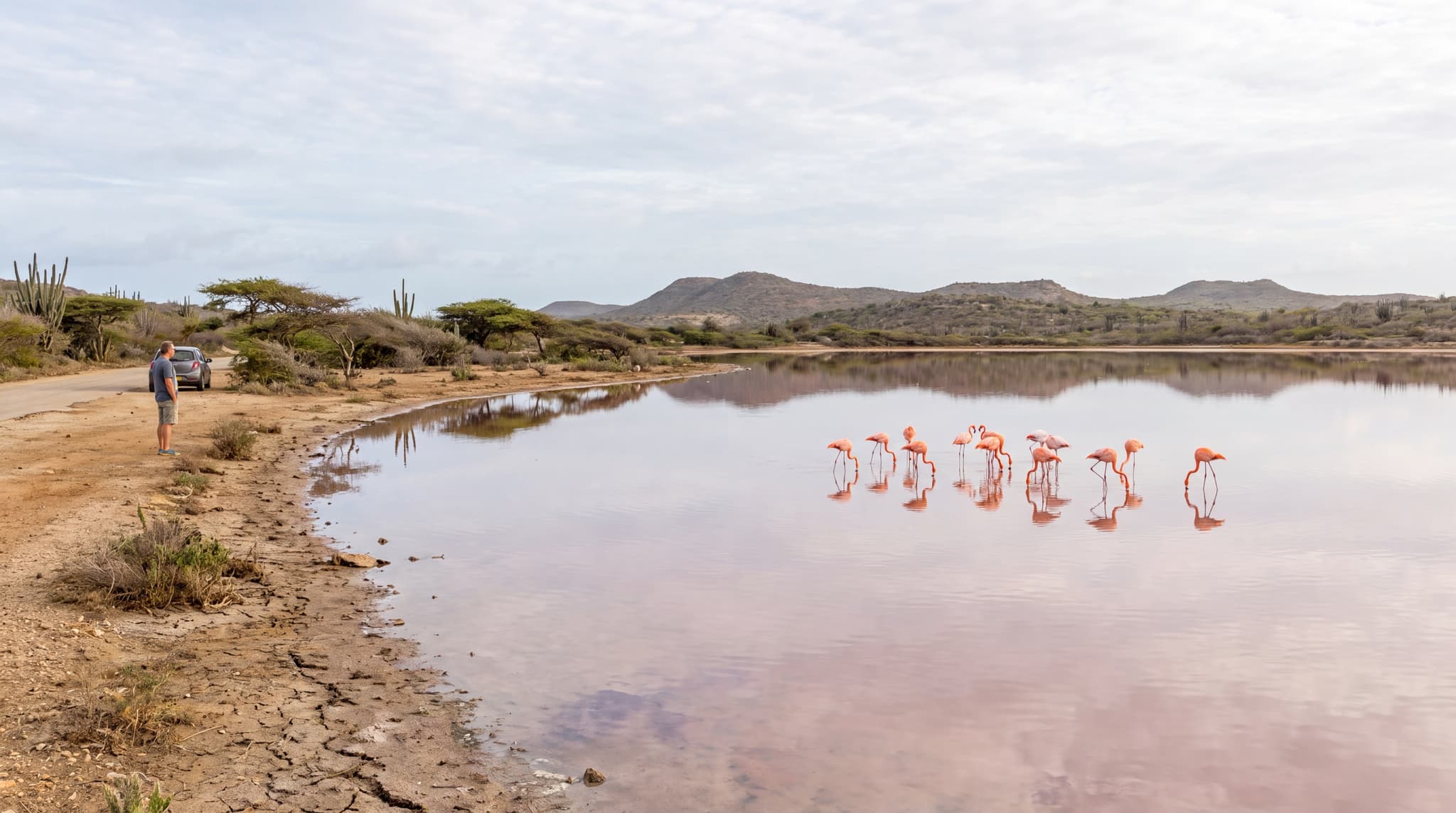
Jan Kok, a shallow salt pond along the road on the way toward the island's west end, is the most consistently mentioned flamingo spot on Curacao, with birds often visible from the roadside without needing to leave your car if you would rather not walk. Getting to either pond on your own schedule means having your own rental car, since public transport does not run a useful route out this way. The pond near Sint Willibrordus, a little further along the same general route, is the other regularly cited site. Both are free, unstaffed, and open to the road, which is exactly why the etiquette below matters: there is no ranger keeping visitors at a respectful distance, so that job falls on you.
Sightings are wildlife, not a schedule. Flamingos move between feeding areas depending on water levels and their own patterns, so a pond that was full of birds last month can look empty on your visit, and the reverse is just as true.
Both ponds sit along public roads with informal pullouts rather than a dedicated visitor parking lot, so drive slowly and watch for other cars stopping suddenly once flamingos come into view. There is no admission gate, no ticket booth, and no fixed viewing hours, since these are working or former salt ponds, not a wildlife park built around the birds.
Let us plan this trip for you
A small curation team builds your days around what you want, share your dates and we'll build the rest.
Why these particular ponds
Flamingos are drawn to shallow, mineral-heavy water because of what lives in it, not the water itself. Their pink color famously comes from pigments in the small shrimp and algae they filter out of water like this, and the same food source that gives them their color is exactly what pulls them toward Jan Kok and Sint Willibrordus rather than toward random points along the coast. Deeper, less saline water simply does not support the same food chain, which is why you will not find flamingos feeding at the beaches on the rest of this list.
The salt-pan history, briefly
The ponds flamingos favor on Curacao are former or working salt pans, part of the island's older salt production industry. The shallow, mineral-heavy water that made these ponds useful for salt in the first place is the same condition that supports the small shrimp and other food sources flamingos feed on, which is why the birds concentrate here rather than at random points along the coast. It is a quiet piece of island history hiding behind a wildlife photo op, and it is worth knowing before you go, even in outline.
Browse 25 Curacao experiences
Each one vetted operator by operator, with the honest note and the cancellation window shown per tour.
Best light, roughly
Flamingos, like most wading birds, tend to be more active feeding earlier in the day and again as the afternoon cools, rather than during the hottest, stillest hours in the middle of the day. Early morning and later afternoon also tend to give photographers softer, more flattering light than the flat overhead sun of midday. None of this is a guarantee; treat it as a reasonable starting point for timing your visit, not a schedule.
How to actually watch them right
Stay on the road or the shoulder rather than walking out toward the pond itself. Flamingos startle at close approach, and a spooked flock that lifts off does not usually settle again nearby, which ruins the moment for you and for everyone who arrives after you. A zoom lens or binoculars do more for your photos than proximity ever will, and a phone camera alone will generally leave you with a wide shot of a distant pond rather than the close-up most visitors picture; set your expectations accordingly rather than walking closer to compensate for the wrong gear.
Do not fly a drone near the pond. The noise and the visual threat of something overhead reads as a predator to wading birds, and drone disturbance is one of the more common, avoidable ways visitors ruin a flamingo sighting for the birds and for other visitors at the same time.
Do not feed them, and do not let anyone in your group approach a bird to get a closer photo. These are wild animals on an open, unprotected pond, not a managed sanctuary with staff and boundaries, which means the only thing standing between a respectful visit and a disruptive one is the visitor's own judgment.
Find your hotel by month, beach & budget
Compare current Curacao rates across the major booking sites in one place, in USD. Most rooms are free to cancel.
Stay in the Curaçao loop
Curaçao news and deals, in your inbox.
Get island news, fresh activity ideas and deals when available, straight to your inbox.
Occasional emails from Curaçao Playbook. Unsubscribe anytime.
Email signup is temporarily paused. Please check back soon.
Browse the latest Curaçao storiesWhat to bring for a roadside stop
This is usually a short stop rather than a destination in its own right, but there is no shade at either pond, so sun protection matters even for a quick visit, especially if you end up waiting a while for birds to come closer to the road on their own. Water is worth keeping in the car regardless, since the drive out to the west end is longer than the flamingo stop itself.
Pairing with a west coast beach day
Jan Kok and Sint Willibrordus both sit along the general route toward Curacao's calmer west coast beaches, which makes flamingo viewing an easy add-on to a beach day rather than a separate trip. Cas Abao and Porto Mari both work well paired with an early flamingo stop before the day heats up, and a guided west-beach-hopping day can string several stops, flamingos included, into a single outing if you would rather not plan the route yourself.
Let us plan this trip for you
A small curation team builds your days around what you want, share your dates and we'll build the rest.
Where this fits in a wider west-end day
Flamingo viewing pairs naturally with a broader west-end plan; if you are already building a day around Christoffel National Park or the beaches along that side of the island, a flamingo stop adds very little driving time and works well as an early or late addition rather than its own dedicated outing. For the wider question of which side of the island to base yourself on, our west side versus east side guide covers the trade-offs, and our things to do guide shows where flamingos fit against everything else worth doing.
What can go wrong
The most common way this goes badly is enthusiasm outrunning judgment: a visitor walks out toward the pond for a better shot, the flock lifts off, and everyone who arrives in the next half hour finds an empty pond instead of the birds they came for. The fix is simple and costs nothing: stay back, stay quiet, and let the birds set the terms of the encounter.
The same logic applies to noise generally. Slamming car doors, raised voices, and groups crowding the shoulder for a group photo all push birds further from the road than a quiet, patient approach would. If a pond looks empty when you arrive, it is often worth waiting quietly for a few minutes rather than assuming the birds are gone for good; flamingos frequently move between the visible parts of a pond and the areas closer to the far shore.
Browse 25 Curacao experiences
Each one vetted operator by operator, with the honest note and the cancellation window shown per tour.
The honest bottom line
Curacao's flamingos are one of the easiest, cheapest wildlife encounters on the island, free, unscheduled, and genuinely wild. The whole experience depends on visitors treating it that way: keep your distance, skip the drone, and let a pond full of birds stay full of birds for the next car that pulls over.