Most travel insurance advice is written as though every reader has the same policy at home. On Curacao that falls apart immediately, because the island's two biggest visitor groups arrive with completely different starting positions. An American arrives with a domestic health plan that mostly stops at the water. A Dutch traveller arrives with worldwide cover that works, up to a ceiling set in Amsterdam rather than Willemstad. Same island, same hospital, two different gaps to fill.
So we have written this as two answers, plus the parts that apply to everyone. Nothing here is a recommendation of a specific policy, because we cannot see your plan and no honest page can tell you that a named product covers a named event.
First: is insurance required to enter Curacao?
No. Curacao's official tourism guidance advises visitors to hold valid medical or travel insurance covering medical expenses. Advises, not requires. There is no proof-of-insurance step in the entry process, and the mandatory pre-arrival paperwork is the digital immigration card, which is a separate thing entirely and which our DI Card guide walks through step by step.
So this is a risk decision, not a compliance one. Which makes it worth doing properly rather than buying the cheapest box-tick.
Want a local to plan the whole trip?
Our concierge builds your days around what you actually want, from $149. A small curation team, never pay-to-play.
If you are American: Medicare stops at the border
Medicare's own page on travel outside the United States is not ambiguous. It states that Medicare usually does not cover health care while you are travelling outside the US, and then it defines the terms: the 50 states, the District of Columbia, Puerto Rico, the US Virgin Islands, Guam, the Northern Mariana Islands and American Samoa are considered part of the US, and anywhere else is considered outside the US.
Curacao is a country within the Kingdom of the Netherlands. It is not a US territory, it is not on that list, and it is not close to being on that list. The exceptions Medicare does allow are genuinely narrow and geographic, covering situations like a foreign hospital nearer than the closest US one, or care on a cruise ship within six hours of a US port. None of them describe a beach week on Curacao.
Two useful nuances from the same page. Medicare itself says that because it has limited travel medical coverage outside the US, you may choose to buy a travel insurance policy for more coverage, and it warns that travel insurance does not necessarily include health insurance, which is a distinction worth reading your policy for. It also notes that Medicare supplement insurance, Medigap, may cover emergency care when you travel outside the US. If you hold a Medigap policy, read that section before you buy anything else, because you may already own part of the answer.
If you are on an employer or marketplace plan rather than Medicare, do not assume the answer is better. Search your own summary of benefits for the words outside the United States. Many US plans cover emergencies abroad on a reimbursement basis, which means you pay first and argue later. The US State Department's standing guidance for travellers is the blunt version: the US government does not pay overseas medical bills, and in many places payment or a deposit is required before services are provided.
If you are Dutch: worldwide cover, capped at the Dutch tariff
The Dutch answer is the opposite shape, and the common misconception runs the other way. Because Curacao is a country within the Kingdom of the Netherlands, people assume care there is treated as domestic. It is not. Curacao sits outside the European Union and outside the EEA, which has two direct consequences.
First, your basisverzekering does have werelddekking, worldwide cover, for medically necessary care during a trip. That is real and it is more than most Americans start with. But the Dutch government's own guidance sets the ceiling: you are reimbursed what the treatment would cost in the Netherlands, and the reimbursement is never higher than the amount Dutch care providers are permitted to charge. If the bill on Curacao is larger than the Dutch tariff, the difference is yours unless something else covers it.
Second, the European health insurance card is no help here. It works inside the EU, the EEA, Switzerland and the United Kingdom. Curacao is in none of those, so the card is a piece of plastic in your wallet on this island.
Third, and this is the one that costs real money, the basisverzekering does not generally cover repatriation or medical evacuation. That is the single most expensive thing that can go wrong abroad and it is exactly what an aanvullende reisverzekering or a dedicated travel policy is for.
Let us plan this trip for you
A small curation team builds your days around what you want, share your dates and we'll build the rest.
What the medical reality on the island actually looks like
This is the part that makes the abstraction concrete, and it is reassuring rather than alarming. Curacao Medical Center in Willemstad is the island's hospital, and its own pages are clear about what it offers. The emergency department is open 24 hours a day, 365 days a year. It has seven treatment rooms plus two large rooms for trauma and resuscitation, and the hospital says it has dedicated resources including a trauma surgeon, a neurosurgeon and other surgical and non-surgical specialists for the most seriously injured patients, adults and children alike. In a genuine life-or-death situation the number to call is 910, and the ambulance service is on the free number 912.
The detail worth planning around is not the emergency route, it is the outpatient one. For an appointment at CMC's clinics, the hospital asks you to bring a referral letter, a card or letter from your insurer, a guarantee letter and valid identification. A guarantee letter is your insurer confirming it will pay. That is a real-world reason to travel with your insurer's 24 hour assistance number saved on your phone rather than buried in a policy document at home, because someone at your insurance company may need to be reachable while you are sitting in a waiting room in a different time zone.
Stay in the Curaçao loop
Curaçao news and deals, in your inbox.
Get island news, fresh activity ideas and deals when available, straight to your inbox.
Occasional emails from Curaçao Playbook. Unsubscribe anytime.
Email signup is temporarily paused. Please check back soon.
Browse the latest Curaçao storiesIf you dive, this is the section that matters
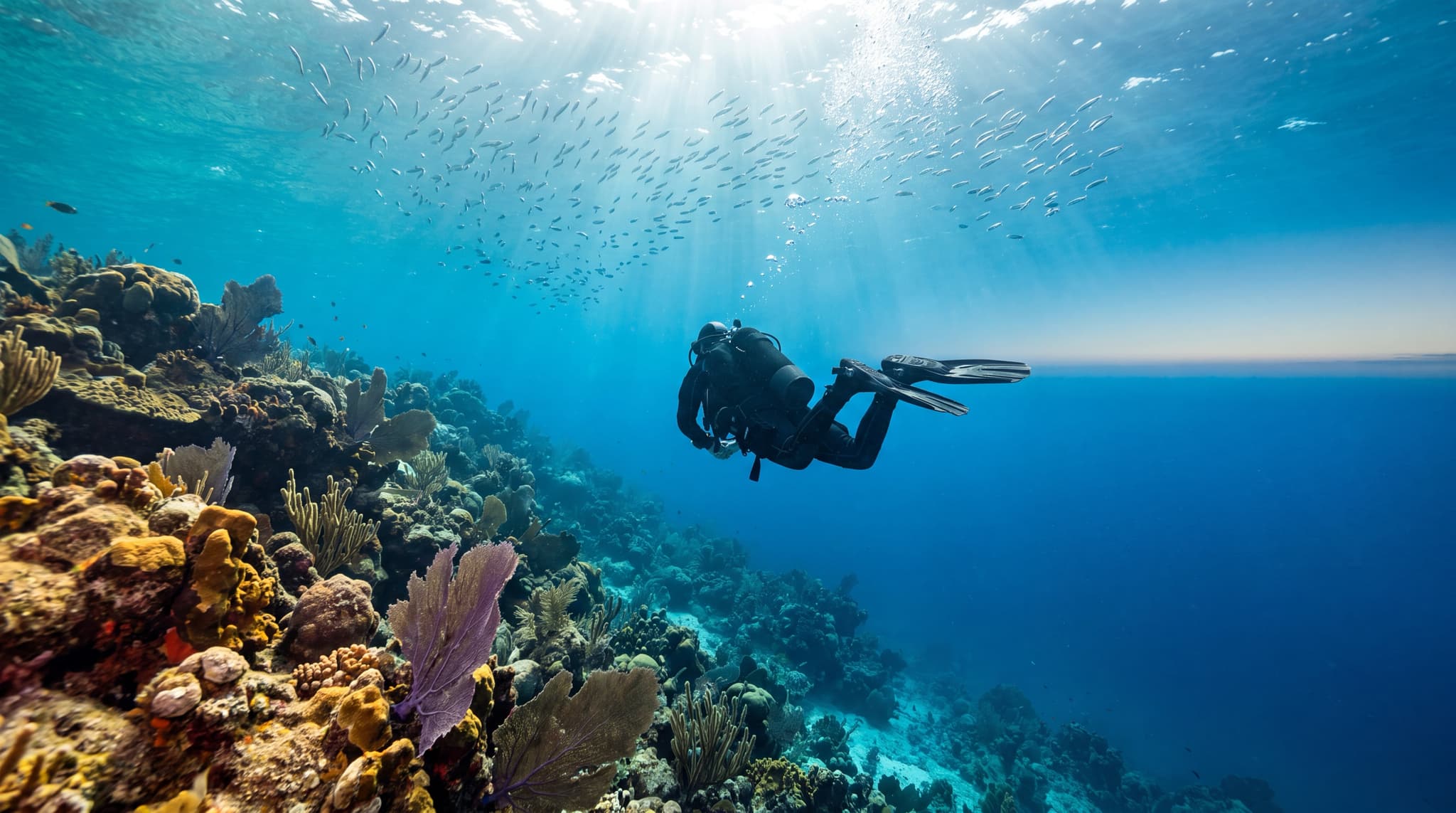
Curacao's signature is shore diving, and that changes the insurance calculation more than anything else on this page. Our shore diving guide covers why the island is set up the way it is.
The good news first: the treatment exists on island. Curacao Medical Center runs a Decompression Chamber and Wound Care clinic, and its own page states that hyperbaric oxygen therapy is a well-established treatment for decompression sickness, a hazard of scuba diving, and that the chamber at CMC is designed to accommodate 10 people. We could not find published operating hours for the chamber itself, as distinct from the emergency department, so if you are diving seriously it is a fair question to put to your dive operator: what is your current chamber and evacuation arrangement, and who do you call.
The insurance side is the part people skip. Recreational scuba is a common exclusion or a conditional inclusion in general travel policies, frequently limited by depth or by certification level. Read the exclusions rather than the marketing page, and if diving is the reason for the trip, dive-specific accident cover exists precisely because standard travel cover often is not built for it.
Browse 25 Curacao experiences
Each one vetted operator by operator, with the honest note and the cancellation window shown per tour.
The one thing you probably do not need to insure here
Hurricane cancellation. Curacao's own meteorological service publishes the numbers, and they are unusual for the Caribbean: on average a tropical cyclone passes within 100 nautical miles of Curacao only once every 11 years, and no hurricane or tropical storm has ever made direct landfall on the island. That is a genuinely different risk profile from the eastern Caribbean, and buying a policy mainly for destination storm cancellation is poor value here.
The honest caveat: your risk is more likely to be at the other end of the journey. A September storm that closes a Florida or New York hub can strand you just as effectively as one over Willemstad. If you want cancellation cover, buy it for your departure and connection risk, not for the island. Our hurricane risk page has the full climatology.
What is genuinely worth covering
Strip away the marketing and four things are doing the work on a Curacao trip. Medical evacuation, because it is the catastrophic-cost item and neither Medicare nor the Dutch basisverzekering handles it. The gap between the local bill and what your home system reimburses, which is the Dutch problem specifically. Trip interruption, if you have prepaid a large share of the trip and cannot absorb losing it. And dive cover, if you dive.
A credit card's built-in travel protection is sometimes real and worth checking first, but it is usually conditional on having paid for the trip with that card and is often secondary to your other cover. Read the card's benefits guide rather than the advertisement. Rental car excess is a separate product again, and we cover how that works on this island in our car rental guide.
Find your hotel by month, beach & budget
Compare current Curacao rates across the major booking sites in one place, in USD. Most rooms are free to cancel.
Three things to do before you fly
Read your existing cover first and write down what it actually pays for outside your home country, including whether it reimburses or pays direct. Save your insurer's 24 hour emergency assistance number in your phone and on paper, because CMC's clinics may want a guarantee letter. And if you are diving, confirm in writing that your policy covers recreational scuba to the depth and certification level you will actually be diving.
When you are comparing policies, the insurance module on our booking hub is where we keep our own shortlist, and our travel tips page collects the practical pre-trip items alongside it. If your underlying worry is whether the island is risky in the first place, our is Curacao safe guide answers that separately and honestly: the realistic risk here is ordinary theft, not a medical emergency.
Reading in Dutch? Our Dutch-language companion to this guide, written natively rather than translated, is at Verzekering voor Curacao.