If you are choosing between January and February on Curacao, almost every guide will tell you the same thing: hot, dry, breezy, high season, book early. That is close enough to be useless. The two months differ in a way the island's own meteorological service is explicit about, and the difference is large enough to change which week you pick.
Here is the version built from the primary numbers: the official 1991 to 2020 climate normals for Hato Airport published by the Meteorological Department Curacao, and the Curacao Tourist Board's own monthly arrival releases.
The counterintuitive part: January is the wet one
The Meteorological Department's climate page states the seasons plainly. The dry season runs from February through May, and the rainy season starts in October and ends in January. January is not the start of the dry season on Curacao. It is the last month of the wet one.
The normals show the size of that gap clearly. January averages 49.5 mm of rain, roughly two inches, spread across 9.1 days with at least a millimetre of rain. February averages 24.5 mm, roughly one inch, across 5.0 such days. February has, on average, half January's rainfall on a bit over half as many wet days.
For context, both months are still dry by Caribbean standards. Curacao's whole year averages 570.0 mm, and November alone accounts for 141.0 mm of it. January's 49.5 mm is a rounding error next to a genuinely rainy island. But if you are choosing between two specific weeks and want the better statistical odds of an unbroken run of beach days, February is the mathematically stronger bet.
Renting a car? Compare every Curacao agency
One search across the island rental companies, free cancellation on most cars, no card to reserve.
What that actually feels like
Not as wet as the numbers suggest. January still averages 271.2 hours of sunshine, which is above Curacao's annual monthly average of 267.8 and, oddly, higher than February's 257.8. A rainy season on a semi-arid island in the Southern Caribbean Dry Zone means a scatter of short showers, not overcast weeks.
Temperatures barely move between the two. January averages a daily maximum of 30.0 C and a minimum of 24.5 C. February runs 30.3 C and 24.6 C. In Fahrenheit that is about 86 for the high in both months and about 76 overnight. Nobody has ever noticed the 0.3 degree difference.
The wind is the variable people forget
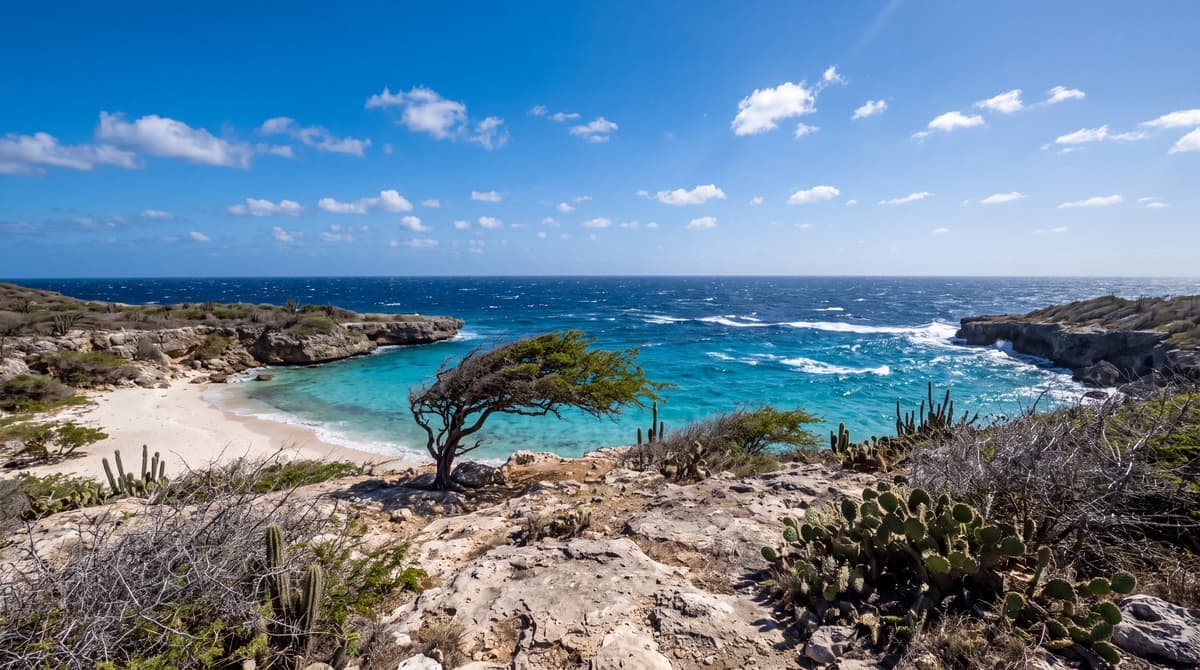
Curacao is a trade wind island and the trades are not constant across the year. January averages 11.3 knots at 10 metres, about 13 mph. February averages 12.2 knots, about 14 mph, which puts it among the windier months of the year behind only June and May.
That one knot matters in two specific places. It matters for the crossing to Klein Curacao, which is a genuine open-ocean run each way and gets noticeably less pleasant in a stiff breeze, something our Klein Curacao guide is honest about. And it matters for exposed stretches of coast, where a windy week shifts the calculus toward the sheltered western coves. If a boat day is the centrepiece of your trip, build in a spare day rather than booking it for the morning you fly home.
Want a local to plan the whole trip?
Our concierge builds your days around what you actually want, from $149. A small curation team, never pay-to-play.
The sea is at its coolest, which is a relative word
The Meteorological Department puts Curacao's sea temperatures at about 27 C on average across the year, coldest around February and March at about 25.9 C and warmest in September and October at about 28.2 C. So February is close to the annual low for water temperature, at roughly 79 F. That is warmer than most people's home swimming pool and nobody who has flown in from a northern winter will describe it as cold. It matters slightly for long dive days, where a thin wetsuit earns its place in February in a way it does not in September.
January is the busiest month of the Curacao year
This is the part worth planning around. In the Curacao Tourist Board's own figures, January 2026 brought 79,387 stayover visitors, up 8 percent on January 2025 with 6,098 more people on the island. February 2026 brought 74,591, up 7 percent.
Put those next to the shoulder and the shape becomes obvious. November 2025 recorded 65,378 stayover arrivals. So January runs roughly 21 percent busier than November for the same island, the same beaches and the same number of hire cars.
Want a local to plan the whole trip?
Our concierge builds your days around what you actually want, from $149. A small curation team, never pay-to-play.
Stay in the Curaçao loop
Curaçao news and deals, in your inbox.
Get island news, fresh activity ideas and deals when available, straight to your inbox.
Occasional emails from Curaçao Playbook. Unsubscribe anytime.
Email signup is temporarily paused. Please check back soon.
Browse the latest Curaçao storiesWho is here in each month, and why that changes the feel
The two months have different visitor mixes, and it shows.
In January 2026, Europe led with 28,922 stayover visitors, North America followed with 25,651 and South America with 21,053. The Netherlands alone accounted for 24,443, up 6 percent year on year, and Dutch visitors stayed an average of 13.7 nights. American visitors numbered 18,069 and stayed an average of 6.4 nights. Canada grew 26 percent to 7,582.
In February 2026, Europe was still ahead at 27,799 but North America had nearly closed the gap at 27,042. The Netherlands came in at 23,460 and Dutch visitors stayed 11.8 nights. Americans numbered 19,622, up on January, staying 6.1 nights. Canada again grew 25 percent, to 7,420.
The practical translation: January skews European and long-stay, with the average visitor across all markets staying 9.4 nights. February skews more evenly between Europe and North America and the average stay drops to 8.6 nights. If you want the island at its most Dutch, with people settled in for a fortnight in apartments rather than cycling through resort rooms, January is that month. If you want a more mixed and slightly faster-moving high season, February.
What is actually scarce, and when to book it
The long-stay Dutch pattern is the thing to understand. Across January and February 2026, between 55 and 59 percent of Dutch visitors chose non-resort accommodation, and they stayed nearly twice as long as American visitors. That means the apartments, villas and holiday homes are booked out in long blocks by people planning months ahead, while resort rooms turn over weekly.
So the scarce commodity in January is not hotel inventory in general, it is the specific kind: apartments and villas that suit a two-week family stay, and rental cars, which get held for the same long blocks. We would book the car at the same time as the flight for a January trip. To be clear about what that is: it is our read of the arrival curve, not a published fleet statistic, because no one publishes one. Our car rental guide covers the practical side and our where to stay guide covers the area choice.
Let us plan this trip for you
A small curation team builds your days around what you want, share your dates and we'll build the rest.
Carnival: what is fixed and what is not
Carnival is the reason many people look at February at all, and it is also where most published information falls apart.
The one fixed anchor for 2027 is Ash Wednesday, which falls on 10 February 2027. The Curacao Carnival season counts backwards from that date: weeks of music competitions and elections, then the parades in the final days, then the season closes.
What is not fixed is every specific 2027 date you will find online. As of late August 2026 the organising foundation FDKK had published no 2027 calendar. We loaded the official Curacao Carnival portal on 29 August 2026 and its events page was still showing the previous season's programme, under a copyright line ending in 2025. If the long-running pattern holds, the Gran Marcha would land on Sunday 7 February 2027 and the Farewell Parade on the evening of Tuesday 9 February. Those are estimates derived from the church calendar, not announcements. Our Carnival 2027 guide keeps the confirmed and unconfirmed separated properly, and our what is on now page tracks the status as it changes.
One structural detail that explains the whole thing. Curacao's labour law does not name a fixed Carnival date. The Arbeidsregeling 2000 defines a public holiday as including the date falling after the date of the Carnival parade. The holiday is legally pinned to the parade, which is why Carnival Monday moves every year and why no one can print a 2027 date until the parade date exists.
What closes, and what to expect on the ground
New Year's Day is a public holiday, and so is Carnival Monday under the definition above. Expect government offices and banks to be closed on both. We could not verify current supermarket practice from an official source, so do not build a grocery run around an assumption either way. Do your shopping the day before and you never have to find out.
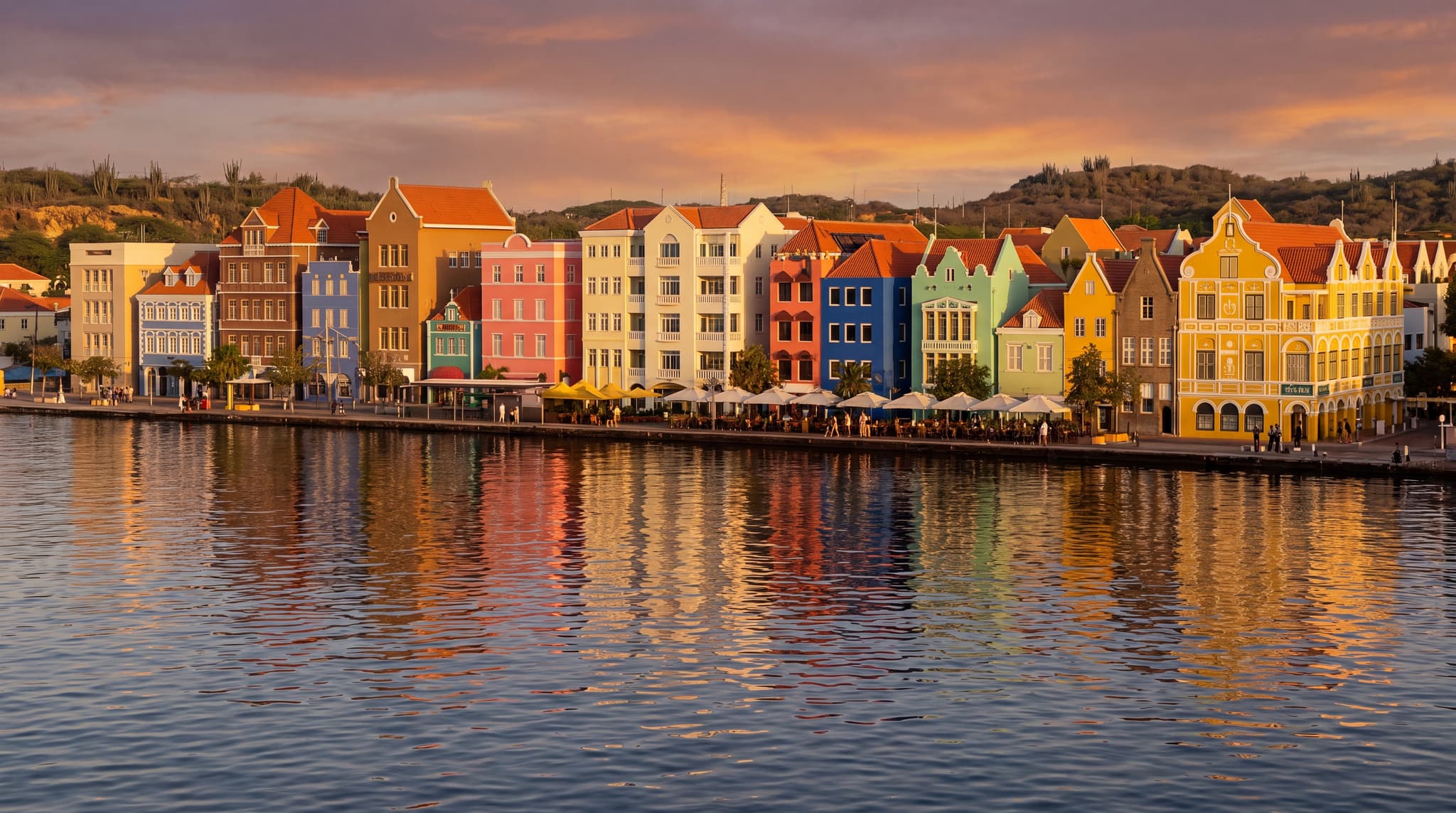
The parades themselves are free to watch from the route, which runs through Willemstad and centres on Otrobanda. Paid grandstand seats from private vendors typically go on sale in the final weeks. Locals stake out positions early, which is the honest reason to arrive well ahead of the published start rather than on time.
Browse 25 Curacao experiences
Each one vetted operator by operator, with the honest note and the cancellation window shown per tour.
So which month?
Come in February if the priority is weather odds. Half the rainfall, half the rain days, the start of the dry season, and Carnival in the calendar if 2027 is your year. Accept slightly more wind and a marginally cooler sea.
Come in January if the priority is the long stay. It is the busiest month, but it is busy with people settling in rather than rushing, the sunshine hours are actually higher than February's, and the small extra rain risk arrives as showers rather than washed-out days. Book the car and the accommodation early and the crowding never really touches you.
Come in neither if the priority is price. Curacao's shoulder is genuinely good, and November's 65,378 arrivals against January's 79,387 tells you what the difference in pressure looks like. Our best time to visit guide sets the full year out, and our December guide covers the month immediately before this one, which behaves differently again.