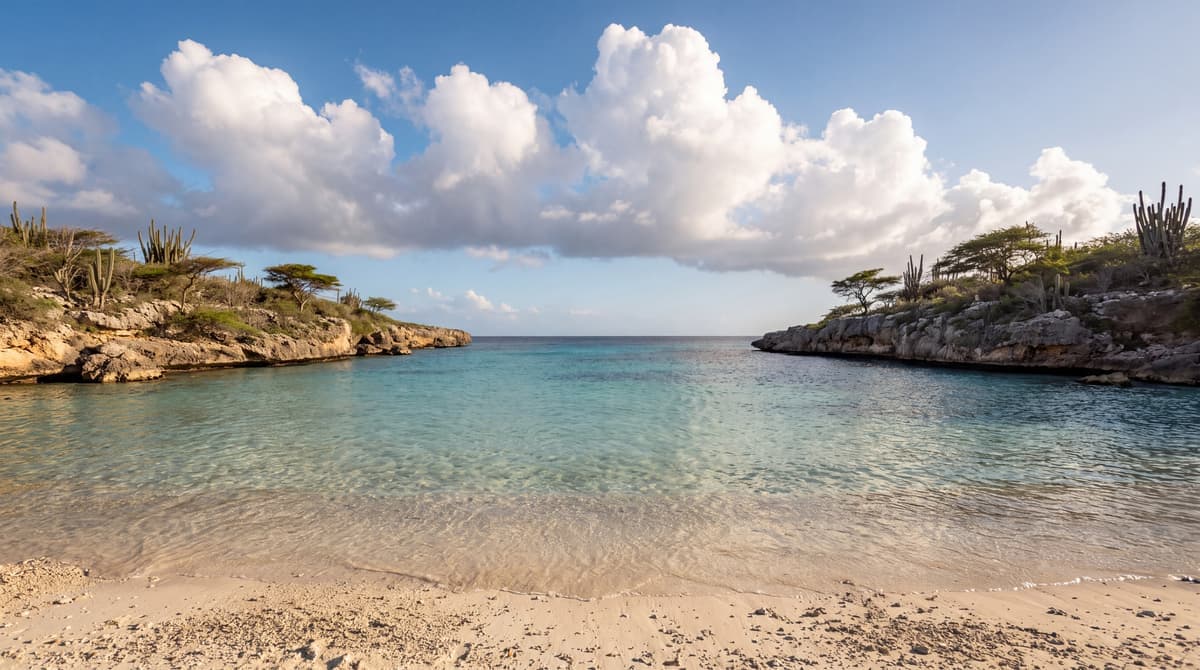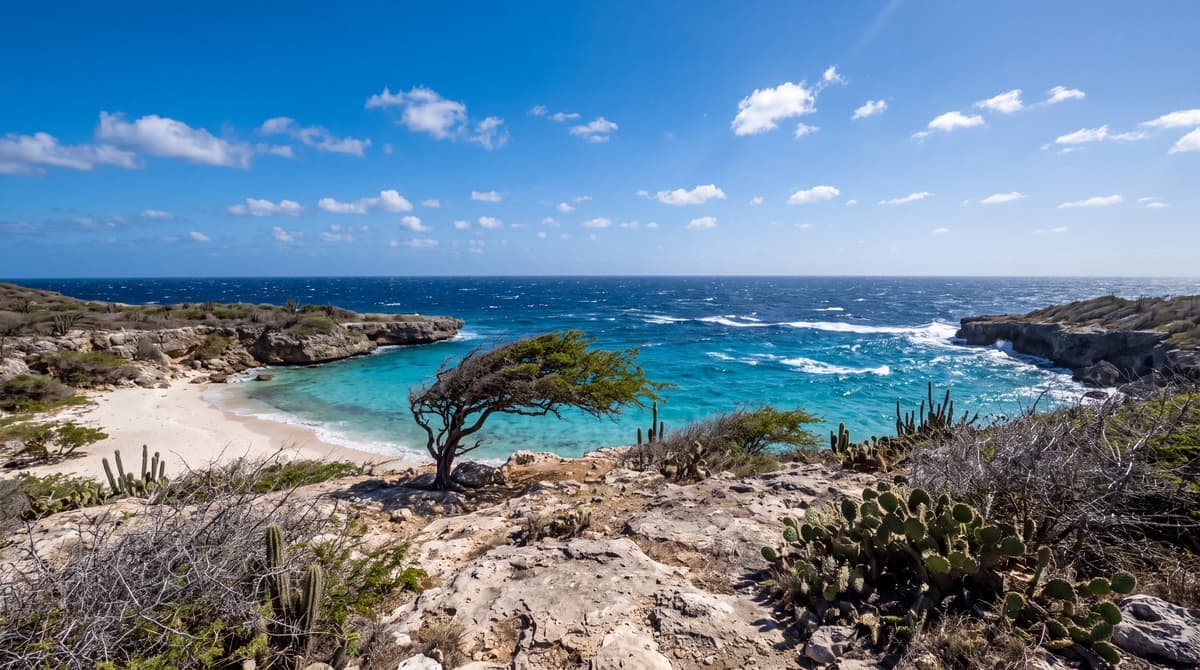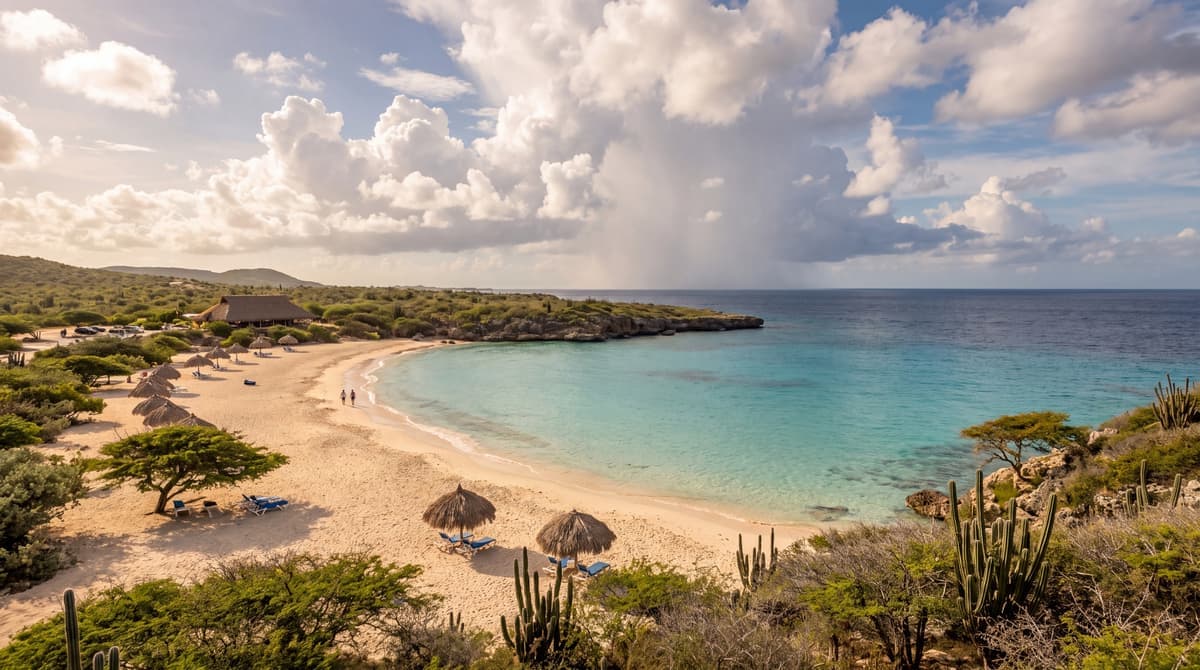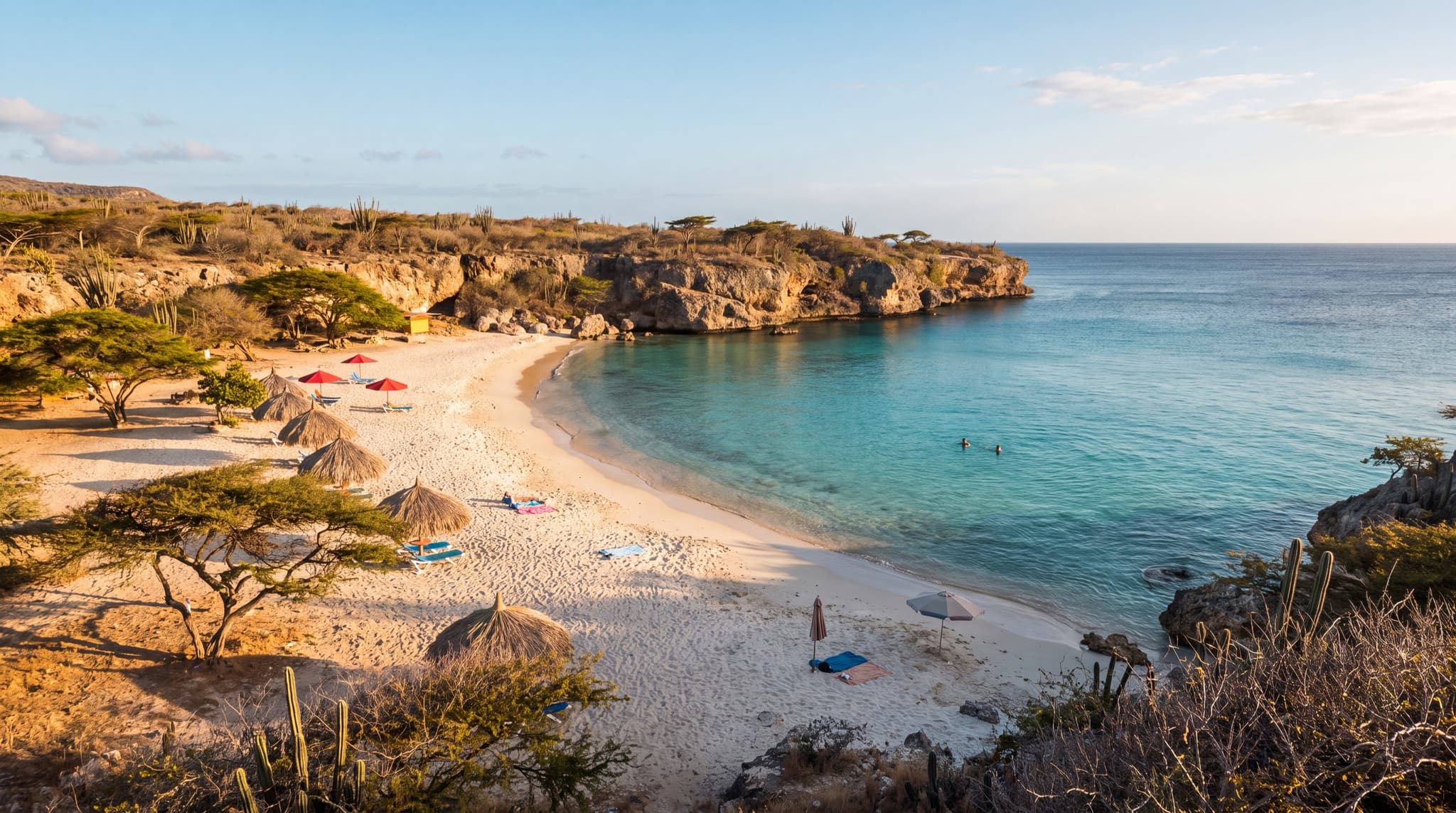
The best time to visit Curacao depends more on what you want from the trip than on avoiding bad weather, because there really is not much bad weather to avoid. The island sits south of the main hurricane belt, stays dry and warm nearly year-round, and only shifts noticeably during its wetter stretch from late October through December. High season for crowds and prices runs December through April; the rest of the year is quieter and generally better value.
What is Curacao's weather actually like?
Curacao has a tropical semi-arid climate, among the driest in the Caribbean, with roughly 500 to 600 millimeters of rain annually, according to data compiled by Curacao's tourism board and Weather-Atlas. Daytime highs run roughly 29 to 32 degrees Celsius (84 to 90 Fahrenheit) year-round, with nighttime lows around 24 to 26 degrees Celsius (75 to 79 Fahrenheit). September tends to be the warmest month, with an average high near 32.6 degrees Celsius (90.7 Fahrenheit), while January is typically the coolest, averaging closer to 29.7 degrees Celsius (85.5 Fahrenheit). None of this is a huge swing. The honest way to describe Curacao's weather is consistent: hot, sunny, and windy, whichever month you land in.
Find your hotel by month, beach & budget
Compare current Curacao rates across the major booking sites in one place, in USD. Most rooms are free to cancel.
When is the dry season?
February through June is consistently the driest stretch, with March most often cited as the single driest month, sometimes as low as 14 millimeters of rainfall, per Weather-Atlas data. If a rain-free week matters most to your plans, this window is the safest bet on paper, though dry season on an island this arid mostly means the difference between occasional brief showers and slightly more frequent ones, not the difference between sun and storms.
When is the rainy season?
Late October through December is unambiguously the wettest stretch, with the wettest single month landing on either November or December depending on the data source, up to roughly 95 to 105 millimeters in the heaviest months. Even then, Curacao's rain tends to arrive as short, heavy showers rather than the multi-day systems some other Caribbean destinations see. Pack a light rain jacket for a late-year trip and move on; it is rarely more disruptive than that.
Want a local to plan the whole trip?
Our concierge builds your days around what you actually want, from $149. A small curation team, never pay-to-play.
Does Curacao ever get hit by hurricanes?
This is where Curacao earns real credit as a shoulder-season pick. The island sits at roughly 12 degrees north latitude, south of the main Atlantic hurricane development zone, and direct hurricane strikes are extremely rare, even during the official June to November hurricane season that puts much of the rest of the Caribbean on alert. We go deeper on exactly what that means for trip timing in our hurricane risk guide. That position is a real, practical reason to consider Curacao specifically for a late-summer or early-fall trip when other islands are riskier bets.
Stay in the Curaçao loop
Curaçao news and deals, in your inbox.
Get island news, fresh activity ideas and deals when available, straight to your inbox.
Occasional emails from Curaçao Playbook. Unsubscribe anytime.
Email signup is temporarily paused. Please check back soon.
Browse the latest Curaçao storiesWhen are crowds and prices highest?
High season across the Caribbean generally runs December through April, tracking North American and European winter, and Curacao follows that same broad pattern: more visitors, fuller hotels, and higher rates. If a lower-key trip with more room to negotiate matters to you, May through November, outside the wettest late-year weeks, tends to be the quieter, better-value window, and it lines up with the island's genuine weather advantage over storm-exposed destinations during that same stretch. For a full breakdown of what a week actually costs depending on when you go, see our Curacao vacation cost guide.
The numbers back this up. Islandwide hotel occupancy hit 88.9 percent in March 2026, with an average daily rate of $305.87, according to Curacao Hospitality and Tourism Association (CHATA) data, both squarely inside the high-season window. Rates and occupancy outside that window are not published with the same level of detail, but the pattern operators describe on the ground matches the general Caribbean seasonal curve: busier and pricier in winter, quieter the rest of the year.
Wind is a constant presence too, whichever month you land in. Curacao sits in the belt of northeast trade winds, which blow fairly steadily and take some of the edge off the heat year-round. Local operators generally describe the wind picking up somewhat in the spring stretch, roughly March through June, though there is no single official month-by-month wind-speed table published for the island, so treat that pattern as a general rule of thumb rather than a precise forecast.
Want a local to plan the whole trip?
Our concierge builds your days around what you actually want, from $149. A small curation team, never pay-to-play.
Are there events worth timing a trip around?
Two recurring events are worth knowing about. Curacao's Carnival season traditionally runs in the weeks leading up to Ash Wednesday each year, bringing parades, Tumba music competitions, and a genuinely festive, crowded stretch to the island; exact dates shift annually with the church calendar, so check the Curacao Tourist Board's events calendar as the season approaches rather than relying on last year's schedule. Our Curacao Carnival 2027 guide tracks which dates are actually confirmed for the coming season and which are only pattern. Later in the year, the Curacao North Sea Jazz Festival brings a major international lineup to Willemstad, with the 2026 edition confirmed for September 3 to 5 at the World Trade Center Curacao in Piscadera Bay, per the festival's own announced lineup. We cover how to build a trip around it in our North Sea Jazz planning guide.
2026 also brings a less typical draw: Curacao qualified for the World Cup for the first time, and the tournament itself runs June through July 2026. If a summer trip is already on your radar, our Curacao at the World Cup guide covers what that means for watching matches on the island.
So, when should you actually go?
If your only priority is avoiding rain, aim for February through June. If you want fewer crowds and better rates without meaningfully worse weather, look at May through November, but book with an eye on late October through December if you would rather skip the wettest weeks. If you are building a trip around Carnival or North Sea Jazz, let the event set your dates and expect the island busier than usual around it. And if a hurricane-free trip during what is technically hurricane season elsewhere matters to you, Curacao's position south of the belt makes months like August and September a genuinely defensible choice here, even though they are peak storm season almost everywhere else in the Caribbean.
Where you stay changes with the season too. Our west side versus east side guide is worth reading alongside this one, since a west-coast, dive-focused trip in the calmer shoulder months feels different from a high-season week based near Mambo Beach or the west-coast snorkel run through Cas Abao, best paired with the west beach hopping experience on our experiences page.
Let us plan this trip for you
A small curation team builds your days around what you want, share your dates and we'll build the rest.
The honest bottom line
There is no genuinely bad month to visit Curacao. The real decision is about crowds, price, and whether an event like Carnival, North Sea Jazz, or the World Cup should anchor your dates. Skip the search for a perfect month that does not really exist here and instead pick based on your budget, your tolerance for a fuller island, and whether any of the island's real annual events line up with your calendar. If you want the day-by-day version once your dates are set, our 7-day Curacao itinerary is the next stop.