The number that talks people out of November is 141 millimetres. That is Curacao's wettest month by the island's own long-term rainfall record, and on a Caribbean calendar the phrase "wettest month" reads like a warning. It mostly is not one. November is the peak of Curacao's modest rainy season, not a monsoon, and it lands in the last stretch of moderate crowds and moderate prices before the mid-December holiday surge takes over. Here is what November is actually like, using the island's own climate normals rather than a regional cliche, along with the honest trade-offs. For the full twelve-month view our best time to visit guide runs every month, and if you are weighing the months on either side, our October guide, December guide and January and February guide cover those in the same detail.
The November numbers, and the context nobody quotes
| November averages | Figure |
|---|---|
| Average high | about 31 C (upper 80s F) |
| Average low | about 26 C (around 80 F) |
| Rainfall | 141.0 mm, the year's wettest month |
| Sea temperature | about 28 C, just off the September to October peak |
| Trade wind | eased, the calmest stretch of the year |
Two of those numbers do the work. The first is the one that scares people, 141.0 millimetres, which the Meteorological Department Curacao records as the single wettest month of the year. The second is the one nobody quotes next to it: the entire year on Curacao totals only 570 millimetres. That is a semi-arid figure. The island sits in the Southern Caribbean Dry Zone, and the cactus-scrub landscape is the climate showing its work. So November is the wettest month of a genuinely dry year, and "wettest" here means a step up from October's roughly 100 to 130 millimetres, not the arrival of a tropical downpour season. The temperatures barely move from month to month on this island; a November day looks almost identical to an October one on the thermometer.
Browse 25 Curacao experiences
Each one vetted operator by operator, with the honest note and the cancellation window shown per tour.
Why the wettest month is still not a washout
Two facts carry the reassurance, and they are the same two that make October work.
The first is when it rains. The Meteorological Department explains that Curacao's rainfall runs opposite to the typical tropical regime: because of the sea and land breeze effect, most precipitation is suppressed during the day and tends to fall late at night or in the early morning. A November rain day on this island is very often a rain night, a wet road at dawn that has dried again by mid-morning, rather than a lost beach afternoon. The second is how the rain arrives, usually as short, heavy showers that pass rather than the grey all-day drizzle the phrase "rainy season" conjures. You should pack for the odd downpour, and our packing list has the specifics, but you are packing for interruptions, not for a write-off.
The El Nino wrinkle for November 2026
This part is a forecast rather than a fact, and it points November 2026 in a helpful direction. The Meteorological Department's own climate summary states plainly that on Curacao "A Nino will suppress the main rain season (Oct-Jan) while La Nina will enhance this rain season." November sits right inside that October to January window. NOAA's Climate Prediction Center, in its ENSO Diagnostic Discussion dated 13 August 2026, has El Nino under an advisory and strengthening, with a greater than 90 percent chance of a very strong event through the fall and winter of 2026 to 2027 and a 69 percent chance the October to December season exceeds any El Nino since 1950. Put those together and November 2026 has a better than usual chance of running below even its 141 millimetre norm. We will not oversell it: the CPC's own wording is that the impacts are more likely but "not guaranteed," and a seasonal signal tells you nothing about the specific afternoon you are on the sand. Take it as a reason not to cancel over a long-range rain forecast, not as a promise of dry skies.
Want a local to plan the whole trip?
Our concierge builds your days around what you actually want, from $149. A small curation team, never pay-to-play.
The sea and the wind: November's real advantage, and its one downside
The sea is November's quiet advantage. The Meteorological Department gives an annual average sea temperature of about 27 C, coldest around February and March at roughly 25.9 C and warmest in September and October at about 28.2 C. November sits just off that warm peak, still around 28 C, which on a snorkelling or diving trip means bathwater-warm entries and long, comfortable time in the water. This is still one of the better months of the year to be under the surface on an island whose identity is shore diving and easy shore-entry snorkelling.
The trade-off is the wind, or the lack of it. October and November are the calmest-wind months on Curacao, with less of the steady trade wind that keeps the winter months feeling fresh. Less wind on a hot island means the air can feel heavier and stickier on land than a breezy January day at the same temperature. By December the trades usually pick back up. It is a fair price for the warm sea and the pre-peak quiet, but it is real, and it is why shade, a beach-club palapa or an early start matters more this month than it does in high season.
Which beaches stay calm, and is the sea rough?
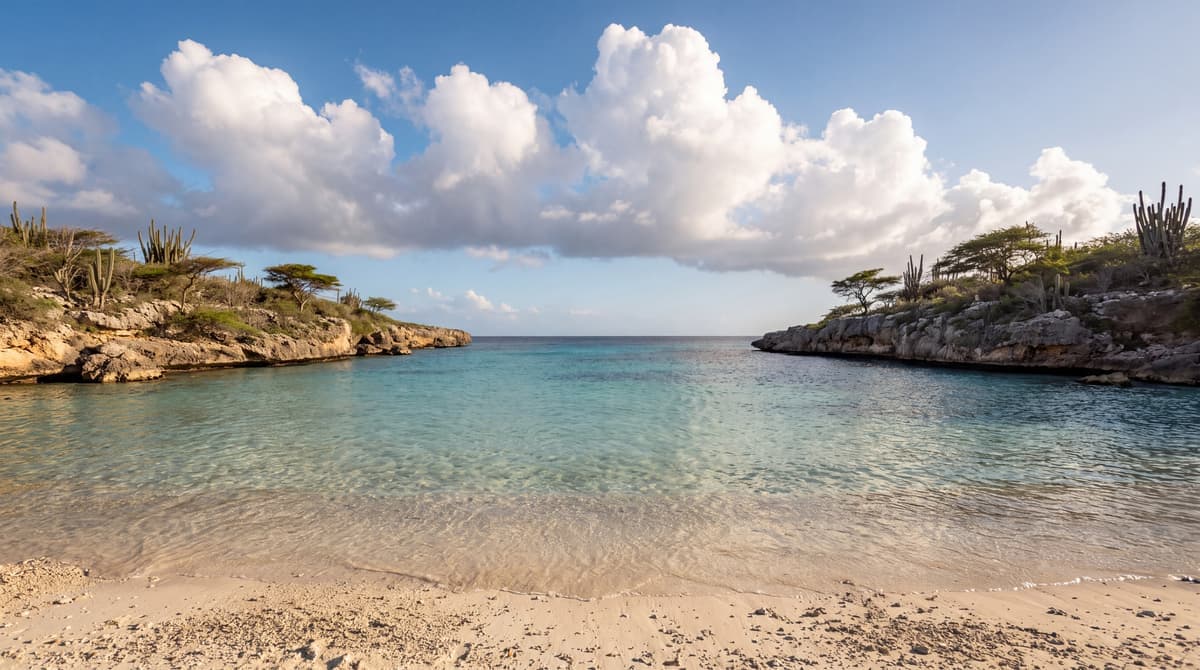
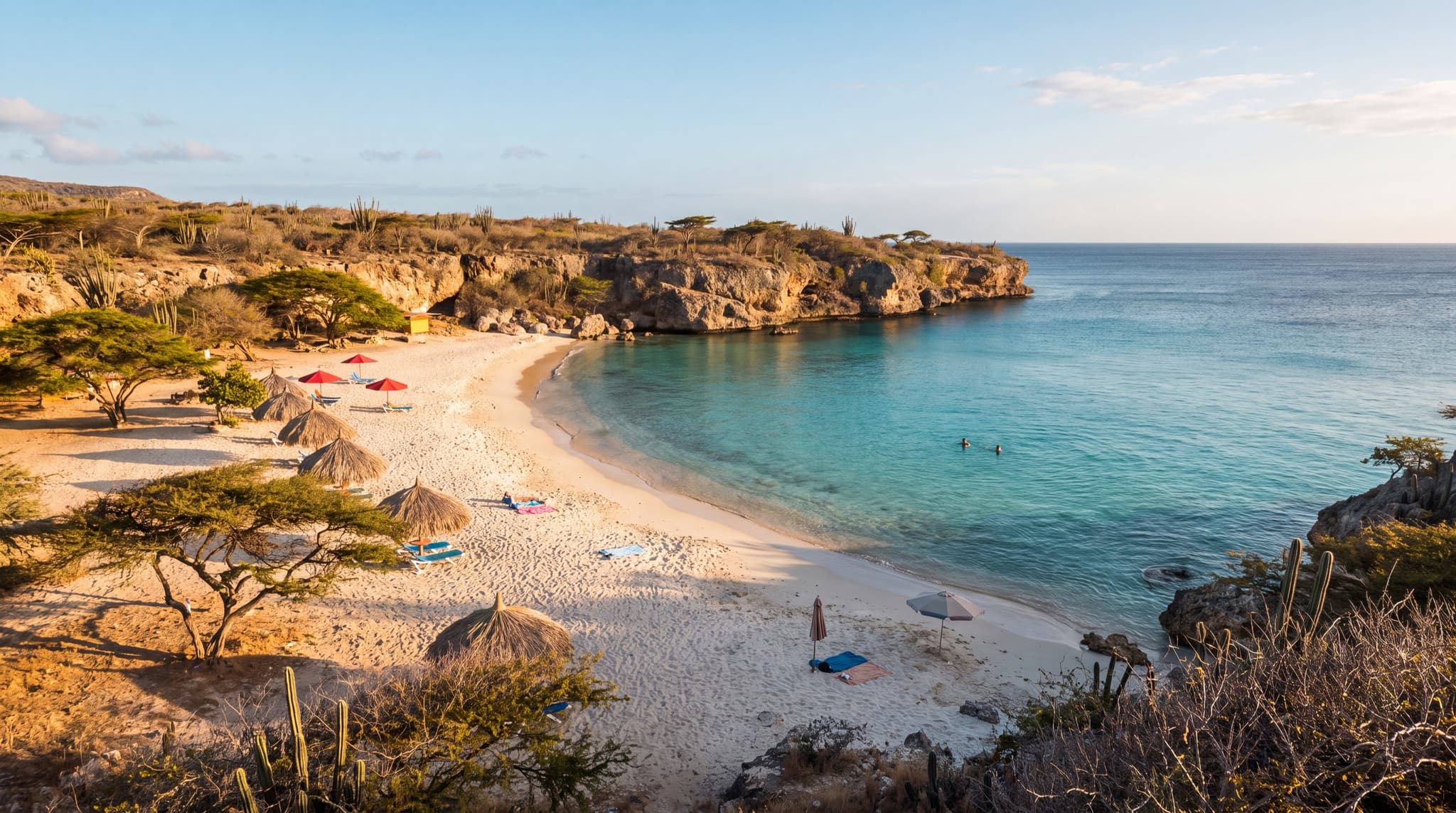
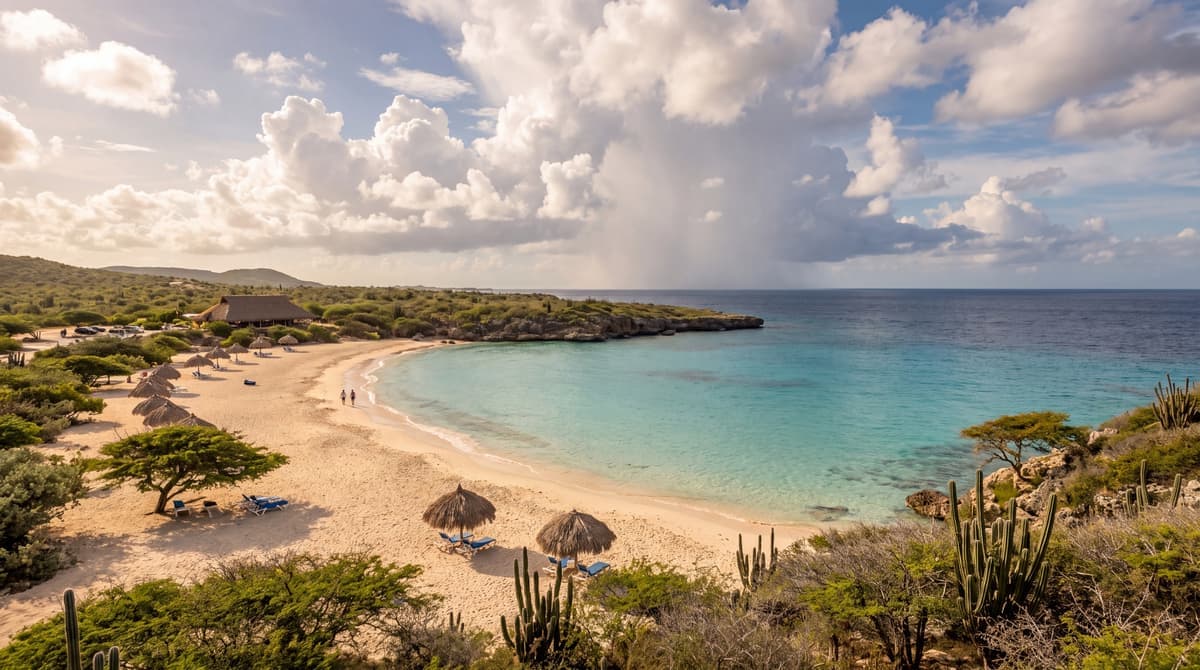
Curacao's leeward south and southwest coast is the sheltered side year-round, and the Meteorological Department's marine guidance puts the highest waves and swell along the northern and western shores, a structural fact of the island's geography rather than a seasonal one. In practice the beach clubs on the south and east side, Jan Thiel and the Mambo strip, are the reliable calm-water option in any conditions, and the west-coast coves such as Cas Abao, Porto Mari and Grote Knip are usually fine. The wild north coast at Shete Boka is where the swell lands on purpose, dramatic to watch and never for swimming. Our beaches hub covers the shelter question beach by beach. If a boat day like Klein Curacao is on your list, book it early in your stay, because sea state, not rain, is what cancels those, and an early booking leaves room to move it.
Want a local to plan the whole trip?
Our concierge builds your days around what you actually want, from $149. A small curation team, never pay-to-play.
Stay in the Curaçao loop
Curaçao news and deals, in your inbox.
Get island news, fresh activity ideas and deals when available, straight to your inbox.
Occasional emails from Curaçao Playbook. Unsubscribe anytime.
Email signup is temporarily paused. Please check back soon.
Browse the latest Curaçao storiesHurricanes: the one month with a calendar answer
November is the month where the hurricane question has a clean, calendar-based answer. The Atlantic hurricane season runs from 1 June to 30 November and peaks from August to October, so by November the most active window is already closing, and by the 30th the season is officially over. Early November sits in the tail of the season; the end of the month sits past it. Either way, what matters most is where Curacao is. The island is at roughly 12 degrees north, outside the main hurricane belt, and the Meteorological Department's record covering 1605 through 2024 counts 37 or more tropical cyclones passing within 100 nautical miles of Curacao, roughly once every 11 years, with no hurricane or tropical storm ever making direct landfall. That is not the same as "no hurricanes ever": Tropical Storm Bonnie passed close in June 2022 and brought warnings, school closures and 3 to 5 inches of rain. "Outside the main belt" is the accurate phrase, not "hurricane-proof," and the strengthening El Nino tends to quieten the Atlantic further. Our hurricane risk page lays out the full record; it is a large part of why the ABC islands draw storm-season travellers in the first place.
Crowds, value, and the December price cliff
Here is the honest surprise about November: it is busier than October, not quieter. The Curacao Tourist Board recorded 65,378 stayover visitors in November 2025, up 9 percent on the year before and a step up from October's 61,013, but still well below December's record 80,891. That is the shape of the month. November is the shoulder climbing toward the December peak, so it is not the island's quietest stretch, but it is the last one before Christmas prices take over. The value case for November is timing, not emptiness: rates and availability in the first three weeks are generally kinder than the mid-December to early-January crush, so if peak-season weather with pre-peak pricing is what you are after, this is the window to book before it closes.
The market mix in November 2025 tells you who is here. The Netherlands led with 21,537 visitors, the United States followed with 15,898, and Canada jumped 60 percent year on year to 6,207, with visitors staying an island-wide average of 8.3 nights. One useful quirk for planning: unlike October, November has no Dutch school holiday. The autumn break, herfstvakantie, falls in October, and the Christmas break, kerstvakantie, not until late December, so November's Dutch visitors skew away from school-holiday families toward couples, retirees and longer independent stays. The one late-month bump on the US side is Thanksgiving, on 26 November in 2026, which nudges a wave of American arrivals into the final week.
No one publishes a month-by-month rate table we could verify, so compare live quotes for your own dates. The one dated island-wide anchor we can point to is the March 2026 hotel average of USD 305.87 a night, per the Curacao Hospitality and Tourism Association, a peak-month figure to hold your November quote against. On money generally, Curacao runs on the Caribbean guilder (XCG), pegged at USD 1 to XCG 1.79 since it replaced the old Netherlands Antillean guilder in 2025, with US dollars widely accepted; our currency guide has the details and our vacation cost breakdown has the budget tiers.
Let us plan this trip for you
A small curation team builds your days around what you want, share your dates and we'll build the rest.
What is on in November
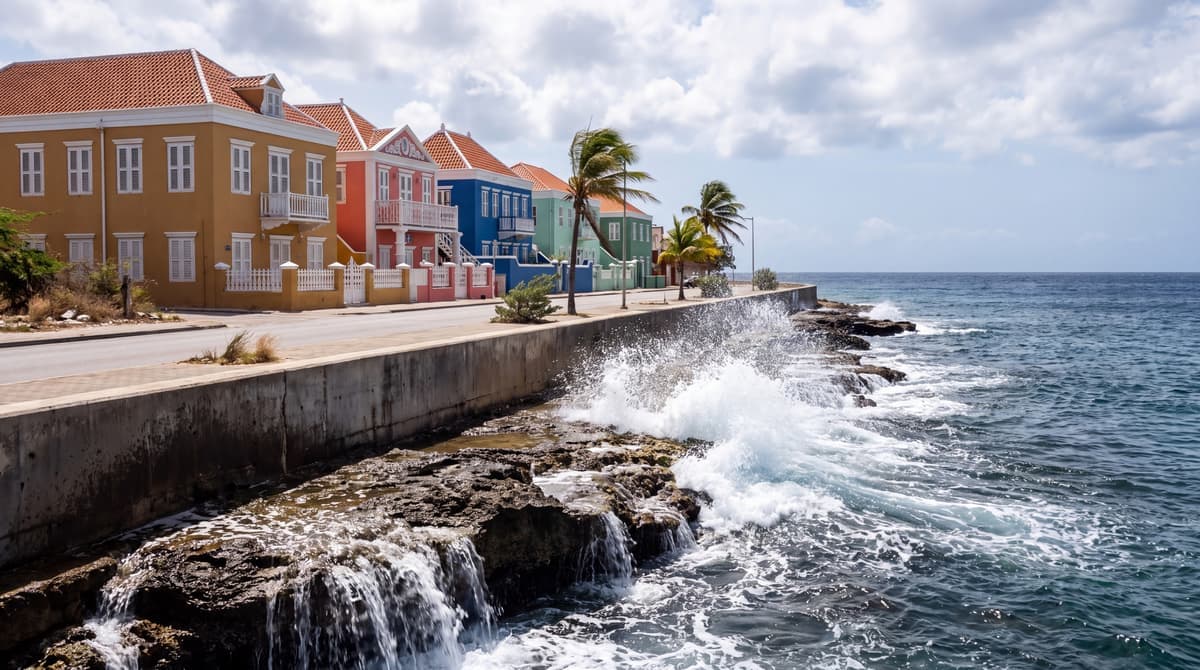
November's event calendar is light, with one clear headliner. The KLM Curacao Marathon takes over Willemstad on the weekend of 28 and 29 November 2026: a 5 kilometre run and walk on the Saturday evening, and the full marathon, half marathon and 10 kilometre races through the early hours and morning of the Sunday, on an internationally certified course along the coast and through the historic city. It draws a large field of overseas runners, so if you are on the island that weekend expect the Willemstad hotels to be fuller and the waterfront busier; if you run, it is a reason to time the trip. The island's other marquee events sit in other months, so a November trip misses them: Curacao North Sea Jazz runs in early September, Curacao Pride in late September into early October, and Carnival in the run-up to Lent in February and March.
November is also the month the island's newest resort comes online. TUI BLUE Curacao is scheduled to open on 1 November 2026 after a phased start from 20 October, adding a large all-inclusive to the island's stock; we cover it and the wider 2026 to 2027 openings in our new resorts guide, and the family-resort picture in our family resorts guide.
Getting around, and where to base yourself
None of the weather changes the rule that governs every Curacao trip: you will want a rental car. The best beaches, the dive sites and the two national parks are spread along a long coastline, well beyond walking distance of any single hotel zone, and November's rain is one more reason to have your own roof and a boot for a spare change of clothes. Our car rental guide covers pickup and insurance. Where you base yourself shapes how much you drive: our west side versus east side guide and where to stay guide walk through the choice, and our 7-day itinerary and 5-day itinerary show how the days fit together. When you are ready to line up the pieces, /book and the activities page are where to start.
Find your hotel by month, beach & budget
Compare current Curacao rates across the major booking sites in one place, in USD. Most rooms are free to cancel.
So, is November a good time to visit Curacao?
Yes, with three honest caveats. It is the wettest month by total, so expect a few more wet mornings than October, most of the rain still arriving overnight. It is the calm-wind stretch, so the heat can feel heavier than a breezy winter day. And it is one step from the December price surge, so it is not the cheapest month, only the last moderate one before Christmas. What you get in return is the warm sea just off its yearly peak, still-easy access to the sheltered south and west coast beaches, a hurricane season that is already closing and officially ends on the 30th, a market that is busy but not yet at Christmas capacity, and, for the right traveller, a marathon weekend and the island's newest resort opening its doors. Pack for sun with a light layer for the odd downpour, book the first three weeks before December rates land, and if seaweed is on your mind, that is a separate question with its own answer in our sargassum guide.