If you have been anywhere near travel news or a beach-vacation forum this year, you have probably seen the photos: normally postcard-perfect Caribbean and Mexican beaches buried under reeking brown seaweed, sun loungers marooned behind a knee-high wall of it. That seaweed is sargassum, 2026 has been one of the worst years for it on record, and the single most common worry we now hear from people eyeing Curacao is a fair one: am I going to fly all this way and find my beach ruined? The honest, encouraging answer is that Curacao is one of the safest bets in the Caribbean for a clear-water beach trip, thanks to where its swimming beaches face and where the island sits. But one of the safest bets is not the same as immune, and the marketing lines calling Curacao flatly sargassum-free are overselling it. Our local team watches this the way we watch the wind and the swell, because it genuinely shapes which coves are worth your morning. Here is the real picture, and how to plan around it.
What is sargassum, and why is 2026 such a big year?
Sargassum is a free-floating brown seaweed, a macroalgae related to kelp, that drifts on the open ocean kept afloat by tiny gas-filled bladders and never attaches to the seafloor. Out at sea it is a good thing, a floating habitat for fish, crabs, and baby sea turtles. The problem is scale. Since around 2011, a vast bloom known as the Great Atlantic Sargassum Belt has formed across the tropical Atlantic each year, a ribbon that in a big year stretches roughly 5,000 miles (about 8,000 kilometers) from West Africa toward the Gulf of Mexico. When wind and currents push it ashore it piles up, and as it rots on the sand it releases hydrogen sulfide, the source of that rotten-egg smell, with large decomposing mats linked to reported respiratory irritation.
2026 has been a monster year. Scientists at the University of South Florida, who track the belt by satellite, class it as one of the biggest on record, running second only to 2025's all-time high, when the belt peaked at roughly 38 million metric tons in the middle of that year. Several regions, including the wider Caribbean Sea, actually set new local records in mid-2026. So the worry is not imaginary; the seaweed really is out there in historic quantities. The question that matters for your trip is simply where it lands, and that is where Curacao's geography does you a favor.
Browse 25 Curacao experiences
Each one vetted operator by operator, with the honest note and the cancellation window shown per tour.
Is Curacao actually affected?
Yes, but far less than most of the Caribbean, and mostly in places you would not be swimming anyway. Curacao consistently ranks among the least sargassum-affected islands in the region. The monitoring group Sargassum Hub, which tracks influxes across the Caribbean, describes the ABC islands (Aruba, Bonaire, and Curacao) as sitting well south and west of the belt's main path, with Bonaire on the front line effectively shielding its two neighbors; in their reading Bonaire takes the heaviest hits, Curacao sees moderate impacts, and Aruba the least. If you are weighing the ABC islands against each other, our Curacao vs Bonaire guide and Curacao vs Aruba guide go deeper on the wider trade-offs.
The key point for a beach trip is which coast gets hit. Sargassum generally washes onto the windward side of an island, the side facing into the wind and open ocean, and on Curacao that is the rugged, largely uninhabited north and northeast coast. Almost none of the beaches you would actually swim at are there.
Why Curacao's swimming beaches stay clear
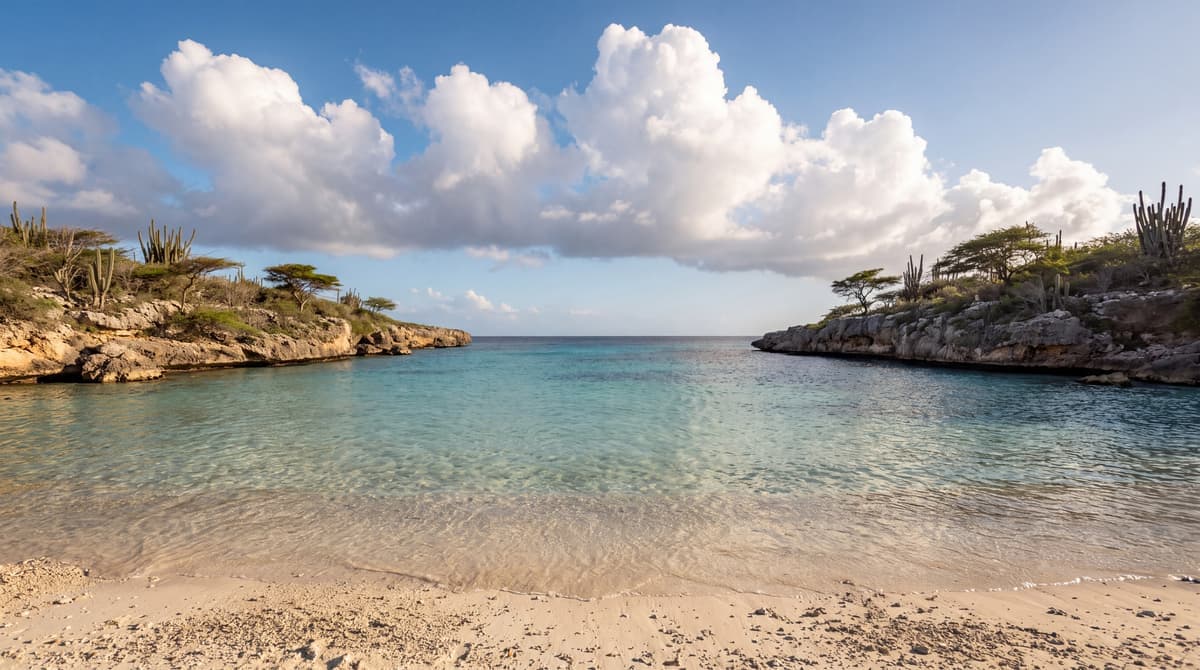
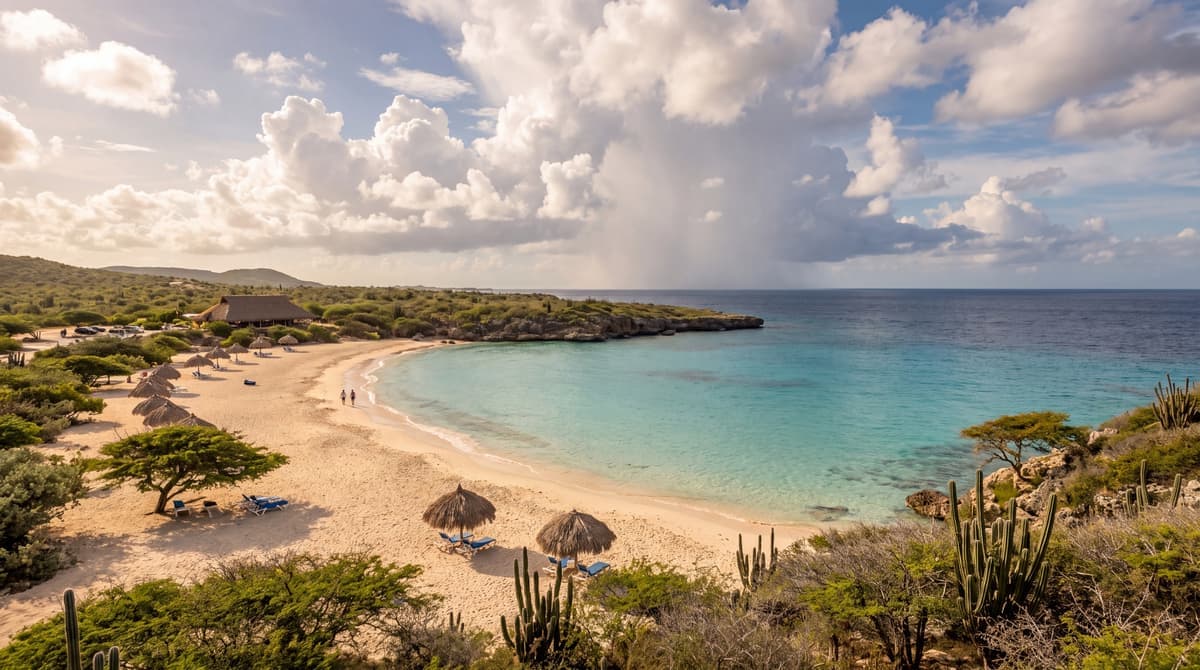
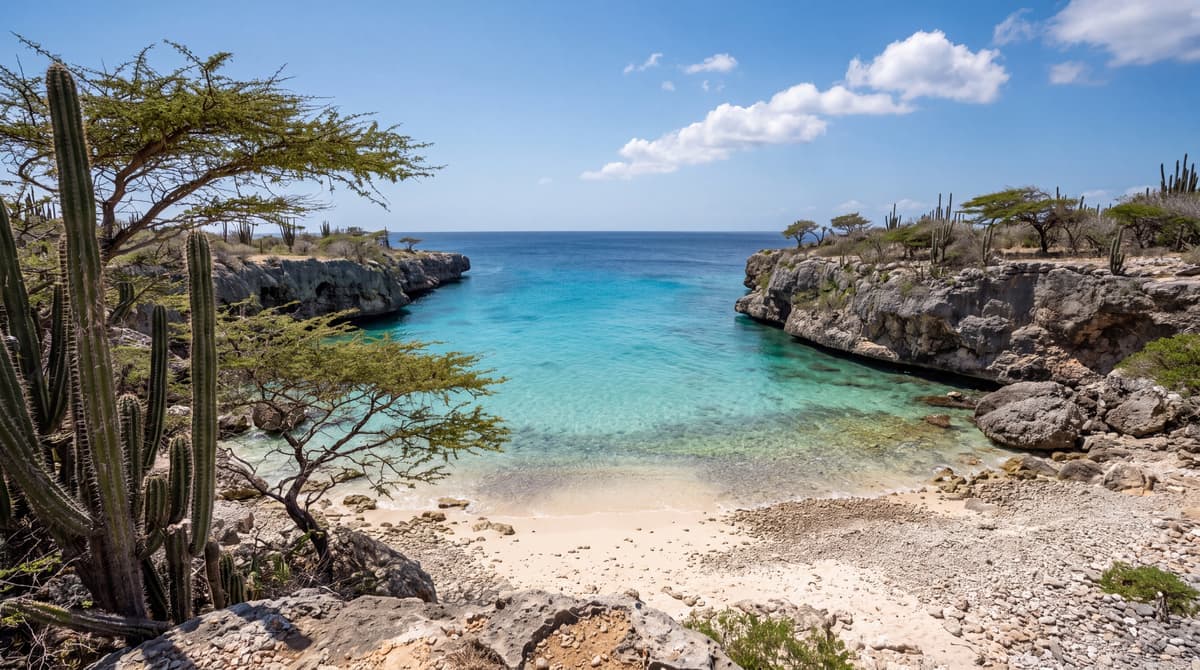
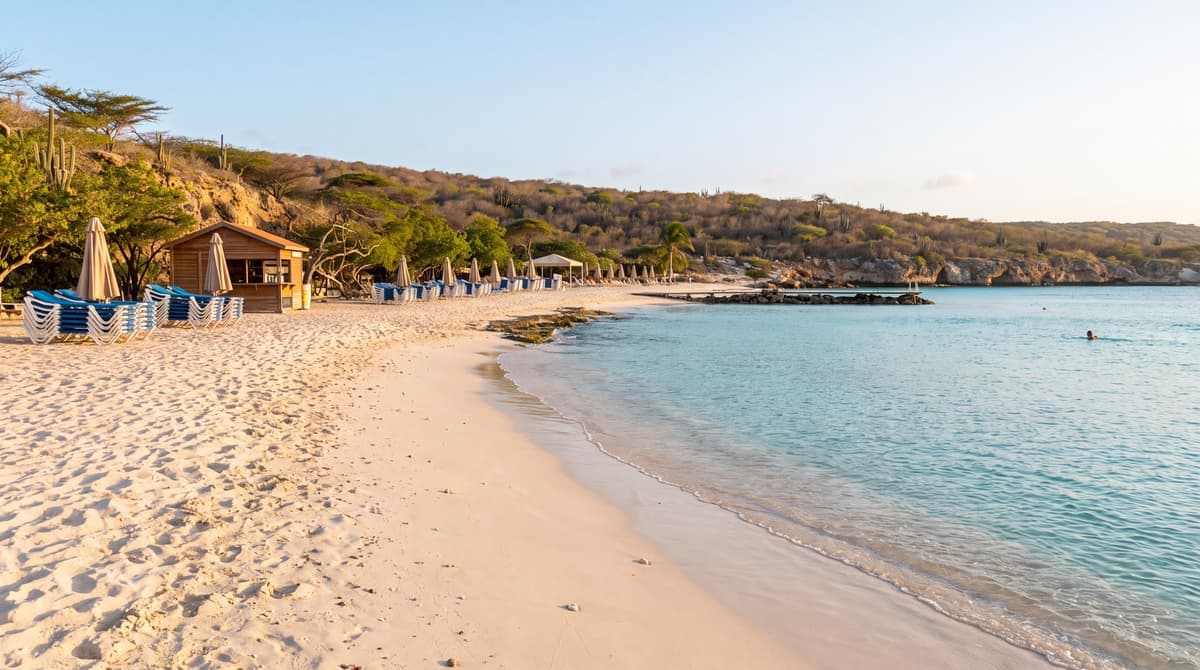
Curacao's whole tourist beach lineup faces the sheltered leeward side, the calm south and southwest coast in the lee of the island. The postcard cove at Grote Knip, the reef-fringed Cas Abao and Porto Mari, the calm Jan Thiel and Mambo strip on the east-south side, and the west-end snorkel coves are all tucked on the protected side, away from the wind and the incoming seaweed. That is the same geography that gives Curacao its famously calm, clear water in general, and it is why influxes on the swimming beaches are the exception rather than the rule. Our beaches hub covers the full leeward lineup.
It is worth saying plainly: this is not a guarantee. Wind shifts, a big enough belt can send patches almost anywhere, and a stray raft of weed can drift into a leeward cove for a day or two before the current carries it back out. What the geography buys you is odds, and on Curacao the odds are genuinely good, better than almost anywhere in the Caribbean this year.
Want a local to plan the whole trip?
Our concierge builds your days around what you actually want, from $149. A small curation team, never pay-to-play.
Where sargassum does show up on Curacao
The honest counterweight to all that reassurance lives on the north coast. In May 2026, the Curacao Chronicle reported thick mats of brown seaweed accumulating in and around Shete Boka National Park, the wild windward stretch of blowholes and rocky inlets, with the decomposing smell hard to ignore in places and scientists describing the volume as far from normal. Sargassum Hub notes that windward inlets like Boka Ascension and Sint Joris Bay take in large influxes several times a year, sometimes enough to fill a bay, with the seaweed usually carried back out to sea naturally and, when it is not, corralled using repurposed oil booms.
None of that is a swimming beach. Shete Boka is a landscape-and-blowhole sightseeing stop, not a place you would bring a towel and snorkel, so an influx there does not ruin a beach day; it just means the north coast can look and smell less pretty during a big push. There is a real environmental cost, though, and it is worth caring about: piled-up sargassum threatens the sea turtles that nest on these shores, trapping hatchlings trying to reach the water and blocking adults from the beach, and its decomposition creates low-oxygen dead zones that stress reef and fish life. The clear leeward water you will enjoy is part of the same ecosystem, so a few reef-safe habits are a small way to give back.
Stay in the Curaçao loop
Curaçao news and deals, in your inbox.
Get island news, fresh activity ideas and deals when available, straight to your inbox.
Occasional emails from Curaçao Playbook. Unsubscribe anytime.
Email signup is temporarily paused. Please check back soon.
Browse the latest Curaçao storiesWhen is sargassum season, and does it matter for Curacao?
In the wider Atlantic, the belt tends to build through spring and peak in late spring to mid-summer, then ease off in the fall as its growth slows, before regrowing again over winter. On the badly hit beaches of Mexico's Riviera Maya or the eastern Caribbean, that calendar matters a lot, and travelers there time trips around it. On Curacao, honestly, it matters far less, because the swimming coast is largely spared whatever the month. We would not reshape a Curacao trip around sargassum season the way you might for Cancun. If you want to optimize your dates, the far bigger levers here are weather, crowds, and price, which we break down month by month in our best time to visit guide. And if part of what drew you to the southern Caribbean was dodging storm risk, the same far-south position that keeps the seaweed at bay also keeps Curacao outside the main hurricane belt.
Let us plan this trip for you
A small curation team builds your days around what you want, share your dates and we'll build the rest.
Curacao vs the worst-hit beaches
If you are choosing between Curacao and other Caribbean or Mexican destinations partly to avoid a seaweed-ruined beach, this is where Curacao pulls ahead. The places seeing the heaviest inundation in 2026, per USF's tracking and widespread reporting, include Mexico's Riviera Maya (Cancun, Playa del Carmen, Tulum), much of the eastern Caribbean and the Lesser Antilles, Puerto Rico, the French Antilles, and stretches of Florida. Those are exactly the mainstream beach destinations a lot of travelers default to, and many of them face the open Atlantic with little natural shelter. Curacao, tucked in the far south with its beaches on the leeward side, is one of the reliable exceptions, alongside its ABC neighbor Aruba. That is a genuine, concrete reason the island keeps climbing clear-water Caribbean shortlists, and it pairs with the other reasons we lay out in our Curacao vs Aruba comparison.
How to plan a beach trip around sargassum
You do not need to do much, but a few habits stack the odds even further in your favor.
Base your beach days on the leeward south and west coast. This is where the clear-water coves live, and it is what almost every Curacao itinerary does anyway. The one honest caveat: those same west-end beaches can get choppy and wind-blown on the windiest afternoons, unrelated to any seaweed, so mornings are generally calmer and clearer for snorkeling. Our snorkeling guide flags the best coves and timing.
Treat the north coast as scenery, not swimming. Shete Boka and the wild windward shore are worth seeing for the drama, but go for the landscape and the blowholes, not a beach day, and do not be surprised to see or smell seaweed there during a big influx.
Check a live sargassum forecast before you travel if you want extra reassurance. The University of South Florida's Sargassum Watch System and public sargassum maps show where the open-ocean belt is heading. The honest limitation: those maps show the big picture at sea, not exactly which cove will be spotless on a given Tuesday, so treat them as a general signal rather than a cove-by-cove promise.
If you do hit a patch, do not panic. On Curacao a stray raft of weed in a leeward cove usually clears within a few days as the current pulls it back out, and there is almost always a clear beach a short drive away on the same coast. Having a rental car, close to essential here anyway, makes it trivial to shift beaches if one looks off.
Find your hotel by month, beach & budget
Compare current Curacao rates across the major booking sites in one place, in USD. Most rooms are free to cancel.
The honest bottom line
Sargassum is real, 2026 is one of the worst years on record for it, and the worry that sends people to search whether there is seaweed in Curacao is completely reasonable. The reassuring truth is that Curacao is one of the Caribbean's more dependable clear-water islands, because nearly every beach you would swim at sits on the sheltered leeward coast and the island lies well south and west of the belt's main path. It is not sargassum-free, the wild north coast around Shete Boka does take influxes several times a year, and no honest local would promise you a guaranteed spotless shore. But plan your days on the leeward coves, keep a car handy to hop beaches, and you are very unlikely to have a Curacao trip touched by the seaweed making headlines almost everywhere else. When you are ready to turn that into an actual plan, our 7-day itinerary and things to do page are the next stop.