If you are reading this from a hotel room while a grey curtain of rain crosses the bay, take a breath: on Curacao it is almost certainly already passing. The worry that a rainy forecast will sink a trip is the single most common one we hear in the October to December months, and it is mostly misplaced. That said, "mostly" is not "always," and the honest answer is a plan, not a platitude. Here is what our local team actually does when the sky opens, what holds up as a genuinely good dry hour rather than a time-filler, and the short list of things worth rescheduling. If you are still choosing dates, our best time to visit guide and the month-by-month pieces on October, November and December cover the weather itself.
First, the honest reframe: most Curacao rain is a wait, not a write-off
Curacao sits in the Southern Caribbean Dry Zone, and the cactus-scrub landscape is the climate showing its work. The whole year brings only about 570 millimetres of rain, a semi-arid figure. Even in the wetter run, the island averages roughly 8 to 10 rain days a month, November is the single wettest at about 141.0 millimetres, and October still logs around 245 hours of sunshine, close to eight hours a day. Two patterns matter more than the totals. The island's Meteorological Department notes that, because of the sea and land breeze, most rain here is suppressed during the day and tends to fall late at night or early in the morning, so a "rain day" is very often a rain night and a wet road at dawn that is dry by mid-morning. And when it does rain in daylight it usually arrives as a short, heavy shower that passes, not the grey all-day drizzle the phrase "rainy season" conjures.
So the first move is often the simplest: wait twenty minutes under an awning with a coffee, or flip the order of your day, trading the beach hour for an indoor one and coming back out when the sun does. Pack a light rain layer and keep plans loose; our packing list has the specifics. When the shower settles in for real, the rest of this guide is your plan B.
Want a local to plan the whole trip?
Our concierge builds your days around what you actually want, from $149. A small curation team, never pay-to-play.
Willemstad under cover
The capital is the best place on the island to be caught in a shower, because so much of it already has a roof. In Punda and Otrobanda the narrow streets are lined with covered galleries, arcades and cafe overhangs, and the painted colonial facades look their moody best with wet cobblestones reflecting them. You can happily spend a couple of hours wandering shops and ducking into cafes, and a shower tends to clear before you have finished a second cortado. Our first-timer's Willemstad guide maps the neighbourhoods, and the walking-tour piece covers the route if you want structure.
The honest caveat: the parts of Willemstad everyone photographs, the Queen Emma pontoon bridge and the floating market, are open-air, so a genuine downpour pauses those the same way it pauses you. A few of the old streets also puddle quickly and drain quickly. Treat the covered core as the shelter and the waterfront as the reward once it brightens.
The Hato Caves: the island's best genuinely-dry hour
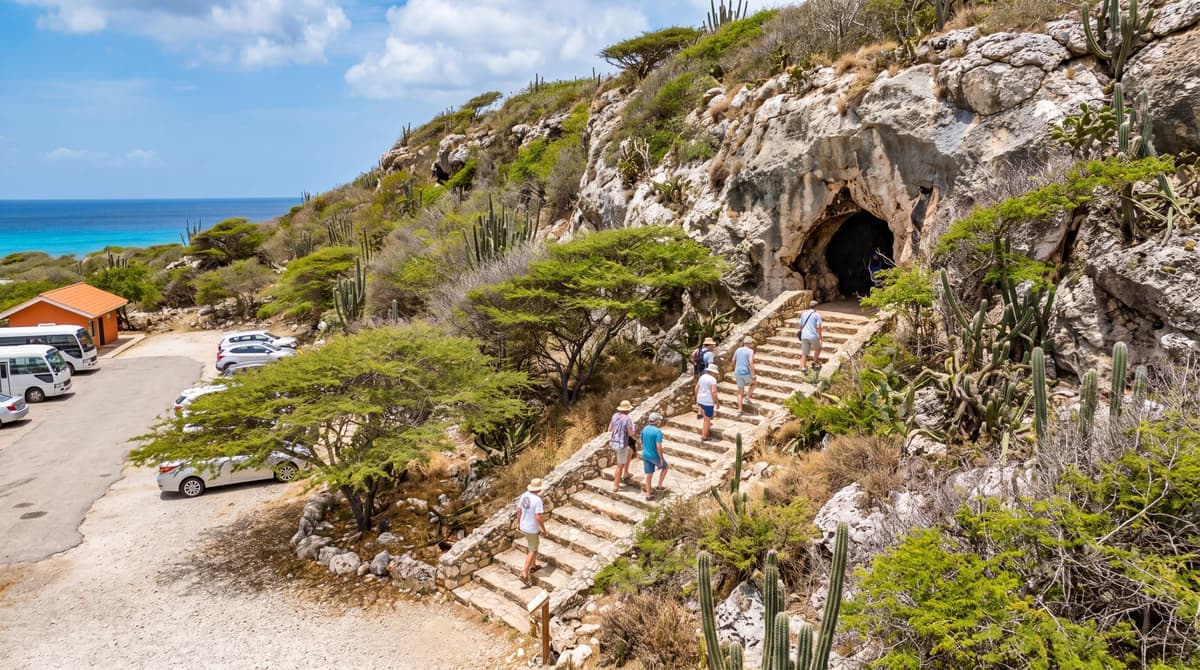
If you want an attraction that rain barely touches, the Hato Caves are it. The limestone chambers near the airport run guided tours daily, on the hour from roughly 9 am to 3 pm, each about 45 minutes past stalactites, stalagmites, a still underground pool and a resident bat colony. Entry is modest, around USD 10 for adults and USD 8 for children, and you go through with a guide rather than wandering alone. It is one of the few things on an outdoor island that is arguably better in cloudy weather. Our full Hato Caves guide has the detail, and you can line it up from the activities page.
Two honest notes. It is a natural cave, so it is humid and the steps can be slick underfoot, and the stairway up to the cave mouth is open-air, so you will get a little wet on the way in during a hard shower. It is also not stroller-friendly. Confirm the current hours and fees before you drive out, since both move from time to time.
Want a local to plan the whole trip?
Our concierge builds your days around what you actually want, from $149. A small curation team, never pay-to-play.
Museums and makers
Curacao's indoor cultural stops are genuinely good, not consolation prizes. The Kura Hulanda Museum in Otrobanda is the serious one: five permanent exhibitions and thousands of artifacts tracing the island's African heritage and the transatlantic slave trade, with English-language guided tours and a depth that stays with you. It is open most days, Monday to Saturday and Sunday mornings, but check current hours. One honest flag: the subject matter is heavy and sobering, so it is a powerful stop for adults and older children but not a light diversion for restless toddlers. For a gentler hour, the compact Maritime Museum over in Scharloo runs you through 500-plus years of the island's seafaring history in about one to two hours; confirm its current days before going, as they are limited.
For something hands-on, especially with kids, Serena's Art Factory out east of Willemstad near the Ostrich Farm is where the island's cheerful Chichi figures are made, and you can paint your own. The drop-in painting sessions run on set mornings with limited spots that fill early, and a private workshop can be arranged, so check the current schedule rather than just turning up. The caveat here is that the Chichi garden itself is partly open-air; the painting studio is the dry part.
The Blue Curacao distillery and a long krioyo lunch
A shower is a fine excuse to do the two indoor things most visitors mean to and skip. At Landhuis Chobolobo, the mansion where the genuine Blue Curacao liqueur is still made, you can tour the small distillery and taste your way through the colours, with cocktail workshops on the calendar too; our Blue Curacao guide covers how to visit. And a wet lunch hour is the perfect time for a slow, roofed-over plate of krioyo cooking, the island's Afro-Caribbean home food, from stews to fresh fish and funchi. Our food guide explains the dishes and the dining hub lists where we send people. A long lunch while the rain drums on the roof is one of the better versions of a Curacao afternoon, weather or not.
Let us plan this trip for you
A small curation team builds your days around what you want, share your dates and we'll build the rest.
The rain-proof default: Sambil and the cinema
When the rain is set in for the afternoon and you simply need somewhere dry with restless people in tow, Sambil Curacao is the honest fallback. It is a large, fully air-conditioned mall about ten minutes from the airport, with international shops, a food court, a bowling alley and a multiplex cinema, and it is one of the few reliably climate-controlled places on the island. We will be straight with you: a mall is not why anyone flies to Curacao, so treat this as a last-resort or a parents-with-fractious-kids move rather than a highlight. But on a genuinely washed-out afternoon it does the job, and a film in a cold cinema while a tropical downpour passes outside is no hardship.
Stay in the Curaçao loop
Curaçao news and deals, in your inbox.
Get island news, fresh activity ideas and deals when available, straight to your inbox.
Occasional emails from Curaçao Playbook. Unsubscribe anytime.
Email signup is temporarily paused. Please check back soon.
Browse the latest Curaçao storiesA spa afternoon
Several of the beach resorts open their spas to non-guests, which turns a grey hour into the one you quietly wanted anyway. It is the obvious move on a honeymoon or a slower trip. Book ahead rather than walking in, since the good slots go, and know that a resort spa is not a budget option. If that is the mood of your trip, our couples and honeymoon guide points at where it fits.
Browse 25 Curacao experiences
Each one vetted operator by operator, with the honest note and the cancellation window shown per tour.
What about the beach and the water?
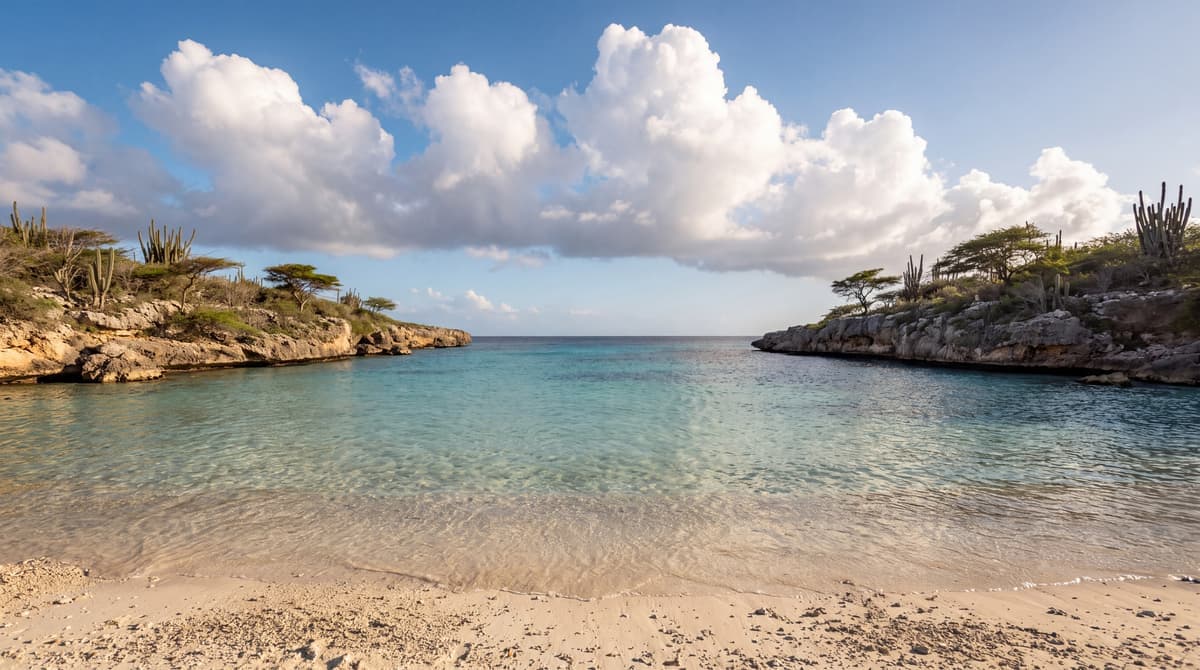
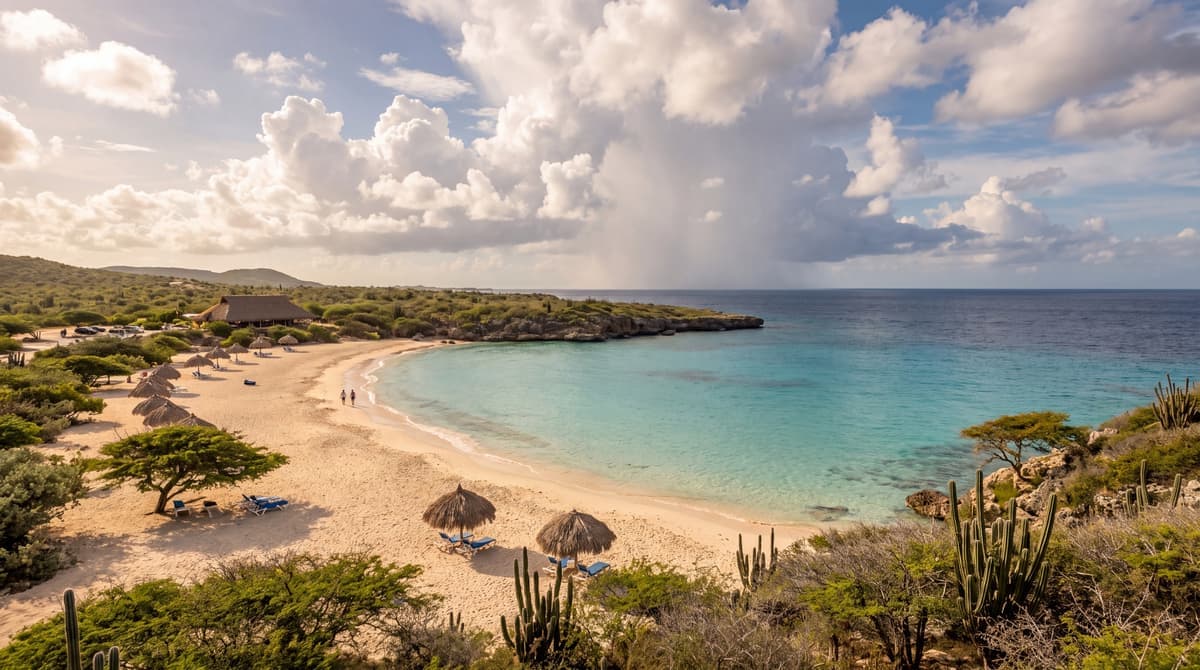
Here is the part people forget: light rain on Curacao is not a reason to leave the water. You are already wet, the sea is warm, around 28 C at its October peak, and a passing shower over a calm cove is genuinely atmospheric. Shore snorkelling and the island's famous shore diving carry on through light rain, and our snorkelling spots guide still applies. The honest limits: the moment you hear thunder or see lightning, get out and stay out until well after it passes, no exceptions. And a heavy, prolonged downpour cuts underwater visibility and can send run-off into the shore sites for a day, so if viz is what you came for, give a hard rain a day to settle.
What to skip on a genuinely wet day
Three things are worth simply moving. The Christoffel mountain climb is the clearest: the rock gets slippery and the trail muddy after rain, and in any case the park does not let you start the summit climb after 10 am because of the afternoon heat, so a wet morning often takes the day off the table anyway. The cliff paths at Shete Boka get slick where the waves already keep them wet, so tread carefully or wait. And the big open-boat days, Klein Curacao above all, are governed by sea state rather than rain; when they cancel it is the wind and swell, not the drops, so book those early in your stay to leave room to shift them. Our Christoffel guide has the hiking detail for when the weather turns.
Find your hotel by month, beach & budget
Compare current Curacao rates across the major booking sites in one place, in USD. Most rooms are free to cancel.
The local rhythm
The thread through all of this is flexibility. Build the day around the forecast rather than against it: take the beach or the hike in the bright morning, hold an indoor hour in reserve for the wet patch, and come back out when it clears, which it usually does. The single thing that makes this easy is a rental car, because it lets you pivot from a rained-out west-coast cove to a dry museum in Willemstad without waiting on anyone; our car rental guide covers the practicalities, and /tips has the rest of the on-island logistics.
So, will rain ruin your Curacao trip?
Almost never. The island is semi-arid, the showers are mostly short and mostly nocturnal, and even the wettest month barely dents the sunshine. Keep your plans loose, hold a dry hour or two in your back pocket, respect the lightning rule in the water, and move the mountain and the boat day if the weather is truly against them. When you are ready to line up the pieces, /book and the activities page are where to start, and our month-by-month guides will tell you what the sky is likely to do.